Project & Insights
Why does my elevator pit keep filling with water?
August 17, 2026
By Boris Gopka, Owner, JSW Waterproofing — elevator pit waterproofing across Toronto and the GTA
Water gets into an elevator pit through seven distinct paths, and in more than half the pits we open, the one that matters is the cold joint where the floor meets the wall. The rest — elevated cold joints between shaft rings, wall cracks, penetrations around the floor beam, the drain running backwards from the sump pit, a void around the piston housing, and occasionally water falling from a roof-level equipment failure — account for the others. Almost every pit has one dominant source, and finding it is the whole job.
Here is what the symptom usually means.
| What you’re seeing | What it usually is | What it takes to fix |
|---|---|---|
| Water sitting in the floor-to-wall corner, all the way round | The base cold joint — the seam between two separate concrete pours | Rout the joint, inject adhesive, patch, then a fiberglass upturn and coating |
| A wet band across the wall six to eight feet up | An elevated cold joint where two shaft rings meet | Same joint treatment, applied at height |
| A crack with white deposits around it | Sustained water flow through the crack | Rout, inject, patch, then coat |
| A crack with yellow-brown staining | Corroding rebar inside the wall, expanding and cracking the concrete | Sound the area first — hollow means patch, not injection |
| Water rising up through the drain, worse after storms | Reverse flow from an overloaded or failed sump pit | Backflow preventer, and get the sump pump looked at |
| Water welling up around the piston | A void around the piston housing filling with groundwater | Fill the void, then an equalizer pipe and a rubber collar |
| Water under the steel beam on the floor | The floor was punctured during equipment installation | The elevator company lifts the beam, we waterproof, they reinstall |
What is a cold joint, and why does the elevator pit leak there first?
A cold joint is the seam that forms where fresh concrete is poured against concrete that has already begun to set, and the two pours never fully bond across it. In an elevator pit that seam is structural history: the shaft goes up first, without a floor, and the floor slab is poured afterwards into the bottom of the completed shaft. Floor and wall cured at different times. The line where they meet is a plane of low adhesion running around the entire perimeter of the pit.
That is why we look there first. If anything in a pit is going to fail, the cold joint fails before it. More than half the pits we open need work at that corner and nowhere else. On a mid-rise in North York with five pits to seal, one of them was already flooded from an active leak, and the cold joint was still the line that had to be treated around the whole perimeter.
The full sequence for treating it — cleaning, slope, joint, coating — is set out in how a concrete elevator pit is waterproofed.
Why is there a second cold joint partway up the wall?
Elevator shafts are poured in sections, and where one section meets the next you can get a second cold joint six to eight feet off the pit floor. These behave exactly like the base joint — a horizontal seam between two pours, with the same weak bond — but they are easier to miss because nobody is looking at eye level for a leak that ends up on the floor.
If a pit is taking water and the base corner is sound, look up.
What do cracks in an elevator pit wall actually tell you?
A crack in an elevator pit wall tells you how much water is moving through it by what it leaves behind. White deposits mean a real, sustained flow of water carrying calcium out of the concrete. Yellow-brown staining means something different: water has reached the rebar in the middle of the wall, the steel is corroding, and corroding steel expands and cracks the concrete from the inside out.
The distinction changes the repair. A little yellow staining and you can inject the crack, be sensible about cost, and leave it. A lot of it and the rebar has expanded enough to delaminate a section of wall, which needs an extensive patch rather than crack filling. The test is not visual — we sound the concrete with a hammer or a rod, and a hollow ring means the area has to come out. There is more on reading the stains and the sounding test, because getting this wrong is expensive: seal over a hollow area and you have trapped water behind delaminated concrete, and it will come back as a bigger patch.
Wall cracks in a pit are usually a pressure story. Static hydrostatic pressure pushing on the outside of the wall, year after year, is what opens them.
Why does the elevator pit floor leak when it’s a foot thick?
An elevator pit floor rarely leaks, because it is typically about a foot thick, and where it does leak the cause is almost always a penetration rather than the concrete. The place to check is the steel beam that runs across the middle of the pit floor supporting the elevator assembly. Water coming up from underneath that beam usually means the floor was punctured when the mechanical equipment went in.
That one is not a repair we can do alone. The elevator company has to remove the beam so the floor underneath can be waterproofed, then reinstall it. We have tried sealing around a beam in place, and it was the wrong call — the water built up enough pressure to burst out from underneath and eroded the concrete at the beam while it did. Not advisable.
Why does water come back up through the elevator pit drain?
Water comes back up through an elevator pit drain when the sump pit it discharges into fills faster than the sump pump can clear it. The pit drain runs down into a sump pit set lower than the pit floor, and a pump lifts that water out to the storm drain. When the same sump pit also serves other parts of the building, or the pump is undersized, failing, or dead, the level rises past the drain line and the flow reverses.
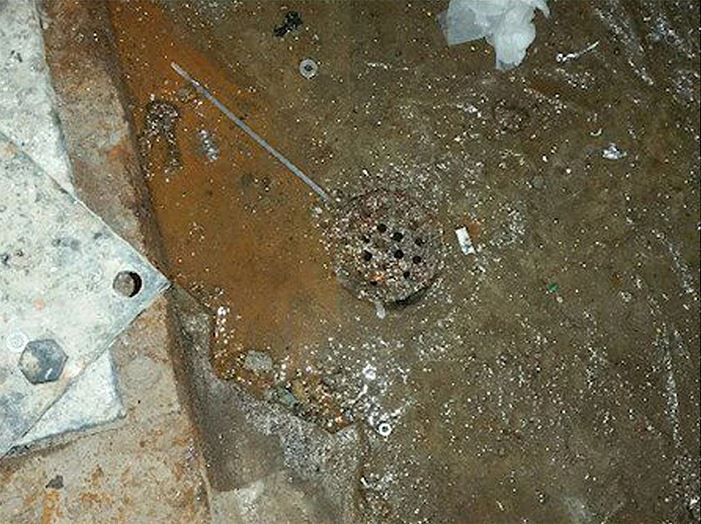
There are three quieter versions of the same problem. Oil is heavier than water, and years of it settling in the drain will clog the bottom half of the pipe. Some drains were installed running up before they run down. And some sit slightly higher than the floor they are meant to drain — barely visible, but it means the pit has to fill to a real depth before gravity does anything at all.
This is the cheapest category of fix on the whole list, which is why it is worth checking early. We now install backflow preventers in the pit drain — first one went into an institutional building on University Avenue in Toronto — and a new or second sump pump is a few thousand dollars against a six-figure pit rebuild.
What is the void around the piston housing?
On a piston-operated elevator, the piston housing is a sealed steel cylinder running roughly twenty feet below the pit floor into the ground, and the void that forms around it fills with groundwater. Buildings under about five storeys usually get a piston rather than a cable system, because it is cheaper to install and run.
The cylinder itself is not the problem. It is sealed, and it does not degrade. The problem is that pushing something that deep through the floor creates space around it, water collects in that space, rises, and arrives in the pit.
Sealing around the piston with concrete does not hold. The housing vibrates every time the elevator moves, and that movement breaks every rigid seal between the housing and the floor. What works is a rubberised collar around the piston at floor level, over a filled void, with a pressure equalizer pipe — and that method is its own article, because it is the most involved work we do in a pit and it costs more than waterproofing the entire rest of the pit put together.
Can water get into an elevator pit from the roof?
Water can reach an elevator pit from the top of the shaft, and while it is unusual it is worth ruling out. Equipment failure at roof level on a high-rise — a mechanical room, a unit sitting near the shaft — puts water into the shaft, and it falls the full height of the building and collects in the pit.
Worth knowing because it is the one source where everything you do at the bottom is wasted effort.
What does it cost to fix?
Elevator pit waterproofing is priced per pit, and the four things that move the number are the drain, the floor slope, whether water is running when we open it, and whether we can physically reach the floor-to-wall corner. A double pit runs about one and a half times a single, and no building loses both elevators — we work one car at a time. What drives elevator pit waterproofing cost goes through each driver.
How do you tell which one it is?
Someone has to get inside the pit and look, and often that is enough — you can see water moving from one side to the other and trace it back. Where it is not obvious we use thermal imaging, which shows the saturated parts of the pit clearly, and read that against the seven paths above.
The part that takes experience is the second question. If you fix the one thing that is broken right now, what breaks next? Sealing a wall does not remove the water pressure behind it; it moves that pressure to whatever is now the weakest point. On pits under heavy pressure that argues for relieving the pressure rather than sealing it out completely — a real trade-off, with real drawbacks, but better than watching a wall cave in.
Where water is actively running rather than standing, nothing can be repaired until the flow is stopped — that is its own technique with a four-hour window.
There is one thing you cannot do first, and everybody does it: power-wash the pit. It looks like the obvious way to clean out years of sediment and oil, and it saturates the concrete so nothing will bond to it afterwards.
What should a property manager do first?
Get the pit pumped, cleaned and inspected while it is empty, and get the drain checked at the same time.
That order matters. A pit full of rubble, sediment and oil cannot be diagnosed by anyone, however good they are, and the drain is both the cheapest thing on the list to fix and the easiest to overlook — we run a camera down the line to the sump pit as part of the same visit. You will often find the answer is a pump and a backflow preventer rather than a waterproofing project. When it is not, at least you will be spending money on the path the water is actually using.
If your pit has standing water, or staining that shows it has flooded before, book an inspection — the staining is what a TSSA inspector reads, and what happens if a wet pit is left alone is a considerably more expensive conversation.
Book a JSW inspection · More on elevator pit waterproofing and concrete crack repair
Common questions
Frequently asked questions
Is water in an elevator pit an emergency?
Water in an elevator pit is not usually an emergency on the day you find it, but it stops being optional quickly. The TSSA can condemn elevator equipment over a pit that shows a history of flooding, and it reads that history off the staining on the walls — so a pit that is merely damp today can still fail an inspection. Water also rusts elevator equipment, which is the expensive part.
Can the elevator pit walls collapse if we leave the water?
The elevator shaft will not collapse if the pit walls fail. The shaft is built as a stack of independent rings that do not bear on each other, so even a completely destroyed pit floor leaves the shaft above standing. What you lose is the elevator: it cannot run without a sound pit, so you are looking at a rebuild before the car moves again.
Does the season change how much water gets into an elevator pit?
Season makes almost no difference to an elevator pit, because the pit sits deep enough underground to stay at a stable temperature year-round. What changes the water volume is groundwater — heavy rain and sudden snowmelt push more water against the shaft. That is why a pit can be dry for months and then flood twice in one week.
Why is there oil in the water in our elevator pit?
Oil in an elevator pit comes from the elevator equipment itself, most often hydraulic oil, and it accumulates on the pit floor over years. It matters for two reasons: oil is heavier than water, so it settles and clogs the bottom half of the pit drain, and it soaks deep into the concrete pores and has to be ground out before any coating will bond.
Can our building's superintendent just pump the pit out?
Pumping an elevator pit out is reasonable as a first step and it is what most property managers do, but it treats the symptom. Pumping also does not tell you where the water came from — and if the pit is full of sediment and debris, nobody can see the entry point at all. The useful version is pumping, cleaning, and then inspecting the empty pit.
Who is allowed to open an elevator pit for an inspection?
Only the elevator maintenance company listed on that elevator can open the shaft and give access to the pit. That company has to be present the entire time anyone is working inside it. A waterproofing contractor cannot let themselves in, so any pit inspection is a three-way arrangement between the property manager, the elevator company and the contractor.
How much water in an elevator pit is too much?
Any standing water in an elevator pit is worth acting on, and staining that shows water has reached half a foot to a foot up the walls is the level that draws regulatory attention. The pit floor is designed to be dry. Elevator equipment sits low in the shaft, so water depth translates directly into corrosion on parts that are expensive to replace.
Related services & repair types