Project & Insights
How do you waterproof a block-wall elevator pit?
August 17, 2026
By Boris Gopka, Owner, JSW Waterproofing — elevator pit waterproofing across Toronto and the GTA
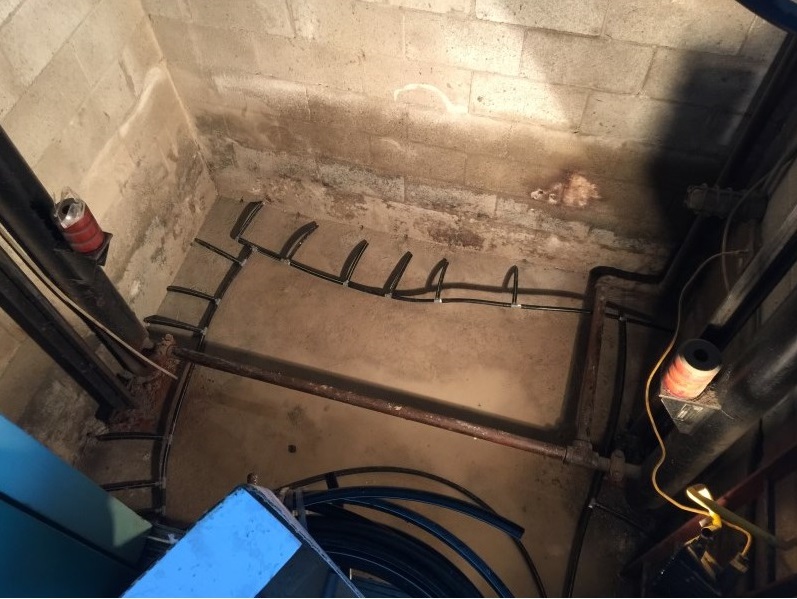
A block-wall elevator pit under heavy hydrostatic pressure should not be sealed completely. Sealing it just means the pressure builds against the wall with nowhere to go, and concrete block gives way sooner than poured concrete does. The right answer is to relieve the pressure — drill the wall and pipe the water to the drain — and accept a real drawback in exchange for not losing the wall.
That is a genuinely unpopular thing to tell a board, so here is the reasoning.
Why block behaves differently from poured concrete
A poured concrete elevator pit has a small number of predictable water paths: the cold joint where the floor meets the wall, sometimes a second joint where two shaft pours meet, and cracks. A block wall has a grid. Hollow cores, mortar joints, and a whole assembly of seams that water can travel through.
It is also weaker. That combination — more paths in, less strength to resist pressure — is why the strategy changes rather than just the price.
What happens if you seal it and walk away
Sealing a block-wall pit against severe, constant hydrostatic pressure accumulates that pressure endlessly against the wall. Nothing about coating the inside face removes the water outside; it only stops it coming through.
Two outcomes follow. The wall degrades extremely quickly under sustained load, or the pit walls cave in altogether. Neither is theoretical on a pit where the groundwater is genuinely pushing.
Worth knowing what a caved-in pit actually costs, because the usual fear is wrong: the elevator shaft above will not come down. The shaft is a stack of independent rings that do not press on each other, so even a destroyed pit bottom leaves the shaft standing. What you lose is the elevator — out of service until somebody rebuilds and waterproofs the base of the shaft well enough to reinstall it.
How pressure relief drains work
A pressure relief drain gives water behind the wall a route into the pit drain instead of a load on the wall. The installation is straightforward: drill through the wall with a one-inch bit, apply adhesive to a pipe, install the pipe into the hole, then connect it to a second pipe carrying the water straight to the pit drain.
Several go in around the pit, not one. When water rises outside and pressure reaches the level where the drain activates, it exits through the pipe and runs to the drain rather than exerting endless force on the block.
The water never touches the pit floor. It is intercepted at the wall and routed.
This is long-standing practice on hollow block shafts rather than something new — we have written before about drilling and draining block-wall elevator shafts, where the holes are piped to the shaft floor drain and the walls then get a triple-layer coating application.
The drawback, stated plainly
Pressure relief drains create water flow around the outside of the elevator pit, and flowing water carves voids in the surrounding ground and structure over time. That is a real cost and it should be said out loud rather than buried.
So it is a trade. On one side, ongoing water movement around the pit and the voids that come with it. On the other, indefinite hydrostatic pressure on a block wall that will either degrade fast or collapse. On the pits where this comes up, the benefit outweighs the drawback — but it is a judgement about which failure you would rather manage, not a repair with no downside.
We ran into the extreme version of this on a group of residential buildings in the Hamilton area. The original design on one of them routed the perimeter weeping tile through the elevator shaft to channel groundwater into the sump pit, so the shaft was being fed continuously, and far harder during rain. On another the weeping tile was performing badly right at the elevator wall and the pressure that built up was severe enough that stopping the water long enough to work took two full days before any repair started.
When the wall itself will not hold a coating
Sometimes the block or concrete is too far gone to bond anything to. On one of those buildings the walls were so fragile that someone struck a wall with a hammer and opened a hole discharging a garden hose worth of water.
Where a wall is that frail, cement boards get glued to the wall surface to give the waterproofing a sound substrate to sit on. It is not elegant. It works — even those installations have lasted well over five years, against the roughly ten years we would expect on a pit with decent concrete to start with.
What a property manager should ask
If your pit is block rather than poured concrete, ask the contractor directly whether they intend to seal it or relieve it, and why.
A contractor who quotes a straight coating on a block pit with heavy water behind it is either not aware of the pressure or is planning to be gone before it matters. The honest quote explains the trade-off, tells you where the relief drains go, and is clear that the pit drain has to be able to handle what those drains deliver — which usually means checking the drain and the sump pit as part of the same job.
Start with an inspection that establishes how much water is actually behind the wall. The seven ways water reaches a pit do not all call for the same answer, and this one is only right for the pits that need it.
Book a JSW inspection · More on elevator pit waterproofing and concrete surface repair
Common questions
Frequently asked questions
Why can't you just seal a block-wall elevator pit completely?
Sealing a block-wall elevator pit completely, where the hydrostatic pressure outside is severe, means that pressure accumulates against the wall indefinitely with nowhere to go. Concrete block is weaker than poured concrete to begin with. The outcome is either rapid degradation of the wall or, at the extreme, the pit walls caving in — so the pressure has to be relieved rather than resisted.
What is a pressure relief drain in an elevator pit?
A pressure relief drain is a pipe installed through the elevator pit wall that lets water behind the wall escape into the pit drain instead of pushing on the wall. We drill the wall with a one-inch bit, glue a pipe into the hole, and connect that pipe to a line running to the drain. When water builds up outside, it exits through the pipe rather than loading the wall.
What is the downside of pressure relief drains?
Relief drains create water flow around the outside of the elevator pit, and moving water carves voids in the surrounding ground and structure over time. It is a genuine drawback, not a technicality. It is accepted because the alternative — indefinite hydrostatic pressure on a block wall — degrades the wall far faster or collapses it outright.
Is a block-wall elevator pit worse than a poured concrete one?
A block-wall elevator pit is harder to keep dry than a poured concrete one, because block assemblies have hollow cores and mortar joints that give water more paths through the wall. Poured concrete has a cold joint at the floor and occasional cracks; block has a grid of potential paths. It changes the strategy more than it changes the cost.
What if the pit wall is too degraded to coat?
Where a pit wall is too fragile to bond a coating to, cement boards can be glued to the wall surface to give the waterproofing something sound to sit on. We have done this on walls so frail that a hammer strike opened a hole discharging a garden hose of water. Even those installations have lasted well over five years.
Related services & repair types