Project & Insights
What do the stains around a crack in my elevator pit wall mean?
August 17, 2026
By Boris Gopka, Owner, JSW Waterproofing — elevator pit waterproofing across Toronto and the GTA
The stains around a crack in an elevator pit wall tell you how much water is moving through it and what the water has already damaged. White deposits mean a heavy, sustained flow. Yellow-brown staining means the water has reached the rebar and the steel is corroding. Two different problems, two different repairs, and reading them wrong is what turns a small job into a large one.
What white deposits around a crack mean
White accumulation around a crack in concrete is calcium being carried out of the concrete by water travelling through it, and a heavy white bloom means there is a real supply of water behind that wall. Not condensation, not an occasional seep after a storm — flow.
That makes it useful. The severity of the white staining is a rough gauge of volume, which is exactly what you want to know before deciding how much of a problem you have. A crack with a light dusting is a different conversation from one with a thick white crust running down the wall beneath it.
What yellow-brown staining means
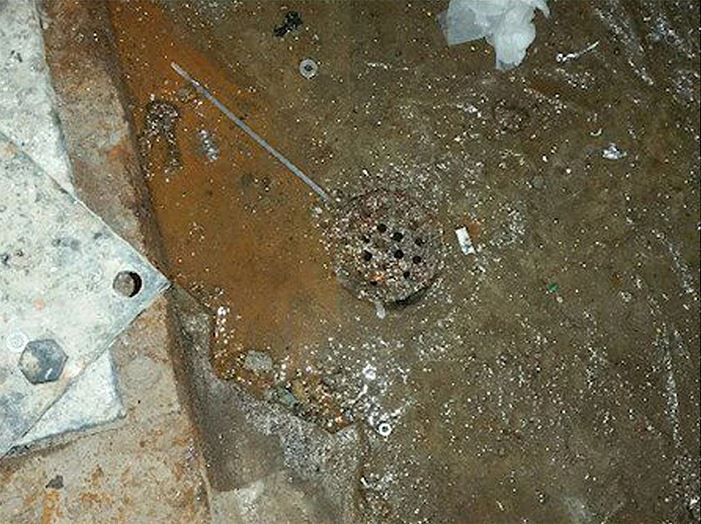
Yellow-brown staining around a crack means water has got through to the rebar in the middle of the wall and the steel is corroding. What you are looking at is rust washing out.
The mechanism runs the opposite way to what people assume. The crack did not let the water in and then the steel happened to rust. Water reached the rebar, the rebar corroded, corroding steel expands, and the expansion cracked the concrete from the inside out. The crack you can see on the wall face is the result of the corrosion, which is why the extent of the staining matters more than the width of the crack.
A small amount, and the sensible answer is often to inject it, be mindful of the cost, and leave it alone. A lot of it means the rebar has expanded enough to delaminate a section of wall, and that needs an extensive patch rather than crack filling.
The sounding test decides it, not the stain
The colour of a stain narrows the problem; a sounding test decides the repair. We tap the concrete around the crack with a specialised hammer or a metal rod and listen. Solid concrete rings. Delaminated concrete sounds hollow.
That test overrules what the wall looks like. An area can appear completely intact and still be hollow behind the face, because the concrete has already degraded and separated internally. If it sounds hollow, that concrete comes out and the area gets patched. If it rings, the crack can be routed, injected and sealed.
Why sealing a hollow area always costs more later
Sealing over a hollow area of an elevator pit wall guarantees a bigger repair later, and in our experience there is no version of this where it works out. Here is why.
The hollow area is the weakest thing in that wall. Seal the wall, stop the water ingress at the face, and the water does not go away — it accumulates behind the delaminated section, which is now the first thing that will break. A hundred percent of the time that leads to a larger area needing patching than the one you started with.
The temptation is real, because injecting a crack is quick and cheap and opening up a wall section is neither. But you are choosing between patching a square foot now and patching several square feet in two years, plus the coating over it.
How the crack repair itself is done
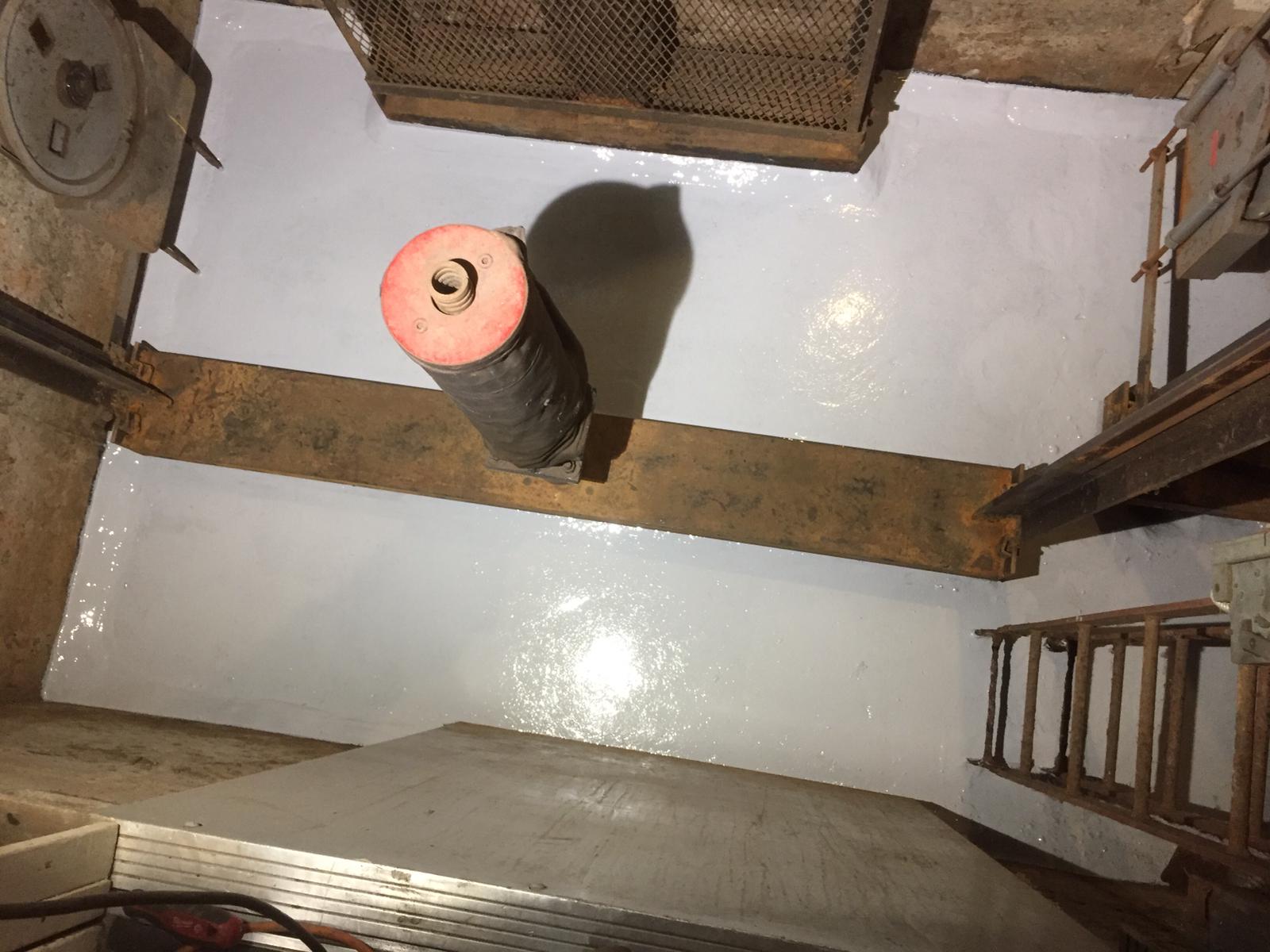
A crack in an elevator pit wall that passes the sounding test gets routed out, injected with adhesive, and patched with a polymer cement that allows a thin application. After the patch cures, we seal the area around the repair with adhesive to equalise the load across the crack we have just filled, then the wall is coated as part of the pit system.
The routing matters more than it sounds. You are opening the crack up to give the adhesive somewhere to key into, not painting over a hairline.
On a pit that had deteriorated badly enough to need restoration throughout, the unsound concrete was removed and patched rather than recast, and the polymer cement used there goes down as thin as 5 mm — which is what makes patching a delaminated area practical instead of a rebuild.
Finding what you cannot see
Where the water path is not obvious from standing in the pit, we use thermal imaging. Saturated concrete reads clearly against dry concrete on an infrared camera, so the wet zones of an elevator pit show up as a map rather than a guess. Combined with knowing the handful of routes water actually takes into a pit, that usually settles where the water is coming from now.
The harder question is the one after that. If you fix the thing that is broken right now, what breaks next? Making one weak point strong redirects pressure to whatever is now the weakest — not weak in the sense of time, weak in the sense of strength. On a pit under heavy hydrostatic pressure, that thinking is what leads to relieving the pressure instead of sealing it out entirely.
What a property manager should take from this
Photograph the cracks in your pit and note the colour of what is around them.
White means volume — you have a real water supply and it is worth finding the source. Yellow-brown means the reinforcing steel is already corroding, which is a slower problem but a structural one. Either way, the useful next step is having someone sound the wall, because that is the test that determines whether you are buying a crack injection or a section of concrete repair, and those are not close in price.
Book a JSW inspection · More on elevator pit waterproofing, concrete crack repair and concrete patching
Common questions
Frequently asked questions
What does white powder around a concrete crack mean?
White deposits around a concrete crack are calcium carried out of the concrete by water moving through it, and the amount tells you the volume of flow. A heavy white bloom means a sustained, significant water supply behind that crack — not an occasional seep. It is the strongest visual signal that a crack is an active water path rather than a cosmetic one.
What does rust-coloured staining on a concrete wall mean?
Yellow-brown staining around a crack means water has reached the rebar inside the wall and the steel is corroding. The staining is rust washing out through the crack. It usually indicates a narrower crack than a white-stained one, because it takes less water to corrode steel than to carry calcium out, but it points to a more structural problem.
What is a sounding test on concrete?
A sounding test is tapping concrete with a specialised hammer or a metal rod and listening to the response. Solid concrete rings; delaminated concrete sounds hollow. It is the test that decides whether a crack gets injected or the surrounding area gets removed and patched, and it finds damage that looks completely sound to the eye.
Can you just seal a crack in an elevator pit wall?
You can inject and seal a crack in an elevator pit wall only once you have confirmed the concrete around it is solid. Sealing over a hollow, delaminated area traps water behind it, and in our experience that leads to a larger area needing patching later — every time. The sounding test comes before the decision, not after.
How do you find a leak in an elevator pit that isn't obvious?
Where the water path is not visible we use thermal imaging, which shows the saturated sections of an elevator pit clearly against the dry concrete. Read alongside the handful of ways water normally enters a pit, an infrared scan narrows it quickly. The harder judgement is predicting what fails next once the current path is sealed.