Project & Insights
Why do parking garage expansion joints leak, and how are they fixed?
August 13, 2026
By Valeriy, Application Specialist, JSW Waterproofing
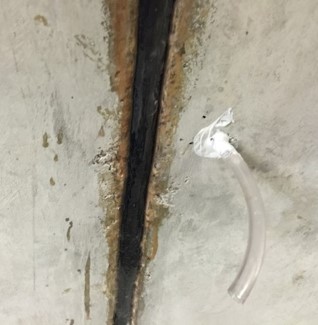
A leaking garage expansion joint almost never leaks where the water got in. Here’s what’s actually failing above your head — and why the fix usually doesn’t mean digging up the deck.
Parking garage expansion joints leak because the waterproofing membrane above them loses its bond to the concrete and lets water run underneath it. The joint itself is usually intact — it is just the place where the water finally finds daylight. JSW seals most of these from inside the garage in about two days, without excavating the deck above.
That distinction decides everything that follows, including whether you are looking at a two-day repair or a five-month excavation.
Find your situation
| What you’re seeing | What it probably means | What it needs |
|---|---|---|
| Water dripping from a line in the ceiling of P1, onto cars | Deck membrane above has debonded; water is travelling to the joint and exiting there | Negative-side injection from inside the garage, ~2 days per 20 ft span |
| Dripping from the ceiling of P2, with a parking level above | Mid-slab joint — moisture tracked in by vehicles settling in the joint | Simpler fix, both faces exposed; gravity feed or a mechanical joint system |
| Dark staining or white deposits on a ledge beam under the joint | Water has been soaking the beam, possibly for years | Seal the joint now; have the beam assessed if there’s rust staining or spalling |
| Cracked asphalt on the deck above a joint that leaks | Tires are pumping water through the crack and hammering the membrane below | Seal the asphalt (~$5/ft) as well as the joint, or the source keeps working |
| Leak only in heavy rain or spring thaw | Membrane breach is small or seasonal, but growing | Inspect now while it’s still one joint |
What an expansion joint is, and why it’s the most common leak point in a parking garage
An expansion joint is the deliberate gap between two concrete slabs that lets them move — concrete expands in heat and contracts in cold, and without somewhere to go, it cracks itself apart. On the ceiling of P1, that gap runs the full span of the slab, typically 20 feet.
Water is kept out of that gap by a flexible loop of membrane material that bridges it, sometimes called a bellows. The loop stretches as the joint opens and relaxes as it closes. Above the loop sits the deck waterproofing membrane — often a bituminous or rubberized sheet — and above that, whatever the building put on top: soil and grass, a playground, planters, walkways, or asphalt.
The joint is the most common leak point because it is the one place in the deck where the membrane has to move, and the one place where a break in the membrane anywhere nearby will eventually drain to.
Why does the membrane above the joint fail in the first place?
The membrane above a garage expansion joint fails in one of two ways, and which one you have depends on what’s sitting on the deck.
Where the area is landscaped and nothing drives on it, the failure is slow. There’s no mechanical damage — it is freeze-thaw cycling and simple loss of adhesion over the years. The membrane debonds from the slab, a crack opens, and water gets underneath the sheet.
Where there’s asphalt on top — a walkway or a driveway lane around the building — the failure is faster and more violent. Asphalt is excellent at cracking. It was never really meant to sit over a hard structural surface. Once it cracks, water gets in, and every tire that rolls over it pressurizes that water into a hydraulic pocket. That pounding does two things: it turns a small crack into a pothole, and it hammers the membrane underneath the asphalt until that fails too.
So an expansion joint that starts leaking is telling you something happened above it. It didn’t leak for no reason.
Why does the leak show up far from where the water got in?
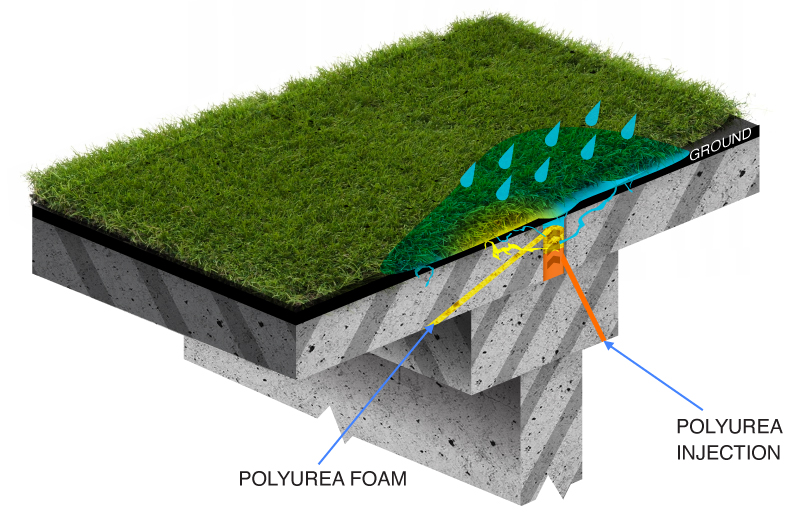
A leaking garage expansion joint rarely leaks anywhere near the actual point of entry. Once water gets under the debonded membrane, it travels along the slab until it reaches the joint — and then it runs down the loop and out into the garage.
On one job we traced roughly 20 feet between the crack where the water was entering and the spot inside the garage where it was coming out. That’s the part property managers find hardest to believe, and it’s the reason so much money gets spent digging in the wrong place. The visible drip tells you where the water is leaving. It tells you almost nothing about where it arrived.
How is a leaking garage expansion joint fixed from inside the garage?
A leaking garage expansion joint can usually be sealed by injecting resin into the joint from inside the parking garage — the underside — rather than excavating the deck from above. The trade term is negative-side application: negative meaning you work from the interior face rather than the side the water is coming from.
The short version of the method: a form is set on the expansion joint from below, and a hydrophobic polyurethane resin is injected behind it. The resin we use is Joint Seal Flex, manufactured in the United States and formulated for this application. It doesn’t react with water and it’s heavier than water, so it sinks through whatever moisture is sitting in the joint and pushes that water ahead of it like a piston. As injection pressure builds, the resin takes the path of least resistance, which is the same path the water used to get in — so it travels back up the leak in reverse and cures in place where the water was.
We’ve written up how the injection resin actually behaves inside the joint in more detail, because it’s the part engineers ask the most questions about.
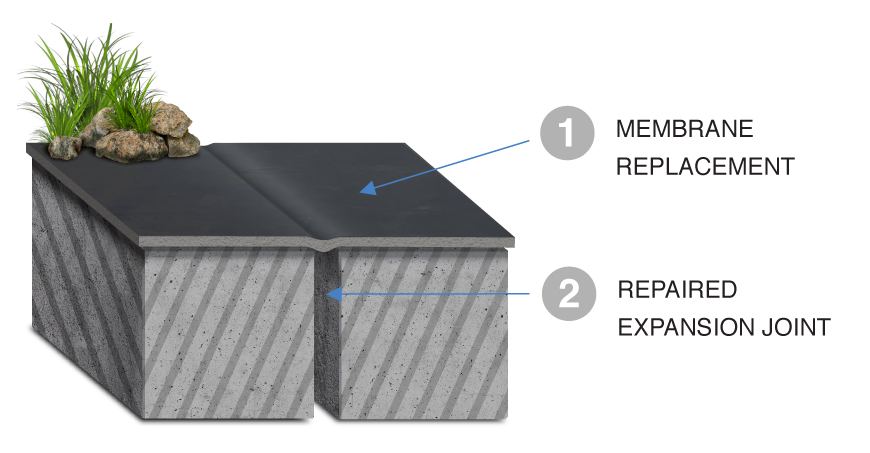
The alternative is digging up the deck — removing the landscaping or asphalt, stripping and replacing the membrane, then putting the surface back. It works, but the excavation and restoration alone are about two-thirds of the total cost before anyone touches the actual waterproofing.
What happens if a leaking garage expansion joint is left alone?
A leaking garage expansion joint gets worse on its own, because flowing water carves voids in concrete and a bigger void carries more water. The problem compounds.
The part that should concern a board is what’s underneath. Garage slabs sit on ledge beams — the large square beams visible from the parking level — and the slabs rest on them freely, like tiles set in place. When a joint above a ledge beam drips for years, the beam stays saturated, and water works on that concrete the same way it works on any other. A ledge beam is a structural element holding the slabs up. That’s a different conversation than a stain on the ceiling. There’s more on what saturated ledge beams look like and why they matter.
What should a property manager do first?
Get someone to look at it and tell you where the water is actually entering, not where it’s coming out.
That’s the whole first step. The difference between a $5-a-foot asphalt crack seal and a $300-a-foot concrete and membrane repair is usually a couple of years of nobody looking. If you have a joint dripping onto cars, or staining on a ledge beam, book an inspection — we’ll tell you what caused the failure and what your realistic options are before anything gets budgeted.
Book a JSW inspection · More on parking garage repair and expansion joint repair
See the work. Examples of garage expansion joint and slab repairs: Lasting Repair and Waterproofing Solutions for Parking Garages · Parking Garage Waterproofing \u2013 Concrete Repairs That Last. More in our projects.
Common questions
Frequently asked questions
How do I know if the leak in my parking garage is coming from the expansion joint?
Water running out along the line of a joint in the ceiling of P1, especially onto parked cars, points to the expansion joint. But the joint is where the water exits, not where it entered — the actual breach in the membrane can be 20 feet away or more. An inspection identifies the entry point before anyone budgets a repair.
Can a leaking garage expansion joint be repaired without digging up the landscaping above it?
In most cases, yes. Negative-side injection seals the joint from inside the parking garage, with no excavation of the soil, playground, or asphalt on the deck above. A typical 20-foot joint span takes about two days and requires roughly ten parking spots to be vacated, rather than a full closure.
Why does the leak appear in a different place than where the water gets in?
Water that gets under a debonded deck membrane runs along the concrete slab until it reaches the expansion joint, then exits there. On one downtown Toronto garage we measured roughly 20 feet between the crack in the membrane and the visible drip inside. This is why digging directly above the drip often misses the failure.
Is a leaking expansion joint a structural problem or just a nuisance?
It starts as a nuisance and can become structural. Garage slabs rest on ledge beams, and a joint dripping onto a ledge beam keeps that concrete saturated year-round. Water deteriorates concrete over time, and a ledge beam carries the slabs above it, so long-term saturation is worth taking seriously.
How long does a garage expansion joint repair take?
A negative-side injection on a 20-foot joint span typically runs about two days: injection and forming on day one, form removal and cosmetic finishing on day two. A top-side excavation repair on the same joint is usually a five- to six-month project with the area fully closed.
Related services & repair types