Project & Insights
Why shouldn't you caulk a crack in a heated concrete ramp?
September 9, 2026
By Valeriy, Application Specialist, JSW Waterproofing
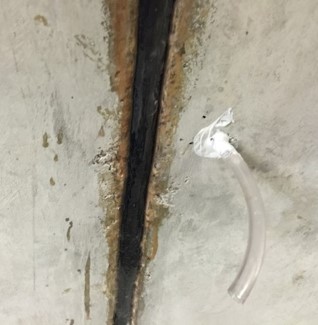
Filling a crack in a heated concrete ramp with caulking or any other rubber sealant sets that repair up to fail, because rubber conducts heat roughly a hundred times worse than concrete does. The heat travelling up through the slab reaches the sealant line and stops. It builds against the rubber, overheats it and cooks it. A cementitious repair keeps the slab thermally continuous, so the heat passes through the repair the way it passes through the concrete either side of it.
This is one of the few places where the right crack repair on a heated slab is different from the right crack repair on an ordinary one, and it is the reason a sealant that performs perfectly well on an unheated garage floor keeps failing on a ramp.
What actually happens to a rubber filler in a heated slab?
A rubber crack filler in a heated concrete ramp becomes a thermal blockage across the width of the crack. Concrete moves heat reasonably well and fairly evenly. Rubber does not — the gap between them is around a hundred to one.
So the ramp heats up and the energy spreads through the slab until it hits the fill line, where it has nowhere to go. It piles up against the back of the sealant. The rubber sits in a hotter spot than anything around it, for as long as the heating runs, every winter. Rubber that is cooked is rubber that hardens, shrinks and lets go of the crack faces.
The failure looks like ordinary sealant failure, which is why it usually gets diagnosed as ordinary sealant failure and replaced with more of the same. On an unheated ramp that diagnosis would be right.
What should go into the crack instead?
A crack in a heated concrete ramp should be filled with a cementitious material, so the repair matches the slab it sits in. The ranking, from worst to best for heat transfer:
| Filler | Heat transfer through the repair | Where it belongs |
|---|---|---|
| Rubber / caulking sealant | Roughly 100x worse than concrete — blocks and cooks | Not in a heated slab |
| Polymer cement | Better than rubber, still short of plain cementitious | Workable, not ideal |
| Cementitious repair material | Matches the surrounding slab | The right answer on a heated ramp |
The product we use is Sika 122 Plus. It carries a corrosion inhibitor, it is adhesive, and it is liquid enough to pour straight into a prepared crack. Once it is in and cured, the crack is cementitious and the rest of the slab is cementitious, and heat moves across the repair rather than banking up behind it.
The corrosion inhibitor is not incidental. Where there is rebar or wire mesh near the repair — and in a ramp slab there usually is — the inhibitor is the reason to specify the Plus rather than anything without it.
Does this rule apply to every crack in every ramp?
No — this is a rule about heated slabs, and heat is not the only thing that decides a crack repair. How much a crack moves still matters, and a crack that opens and closes seasonally puts strain on any fill placed in it, which is why repaired cracks reopen. On a heated ramp those two considerations have to be weighed together rather than one overruling the other.
What the heat changes is that a soft rubber fill is no longer the safe default it would be on an unheated slab, because the material is being cooked from the moment the system runs. Where movement and heat both matter, the crack is worth looking at on site rather than deciding from a spec sheet.
Does this change how the crack gets prepared?
Preparation for a cementitious crack repair in a heated ramp is the same work as any other crack repair, with one addition: the heating cables have to be found and marked first. The material choice does not remove the cable risk, because routing a crack open still means putting a tool into the slab.
That means the mark-out comes before the crack work — every heating circuit energised, a thermal camera pass, cable runs painted on the deck. The full method is in our article on finding the heating cables before repairing a heated garage ramp.
Ramp cracks are rarely short. On a ramp crack repair at a commercial building on Edgeley Blvd in Vaughan we repaired 22 linear feet of crack in a single ramp — a useful number to hold in mind when a quote arrives describing “a crack” as though it were a hand-sized thing.
Why does this matter beyond the sealant itself?
A failed crack repair in a garage ramp is a water path into the slab, and that is the part that costs money later. Water in the crack carries chloride from road salt down to the reinforcing steel. Corroding steel expands, and expanding steel breaks concrete apart from the inside.
On a heated ramp there is a second cost. The heating element is in or under that slab, and a crack feeding water toward it is not a situation anyone wants running for years. A repair that fails every season because the material was wrong keeps that path open.
The reason to get the material right the first time is not the sealant budget. It is everything the open crack lets through while the wrong sealant is quietly cooking.
What should a property manager ask before approving the repair?
Two questions, and both are answerable in a sentence:
- Is the ramp heated, and does the contractor know it? If the quote does not mention the heating, the contractor may not have registered that it is there.
- What material is going into the crack? If the answer is a caulking or a flexible sealant and the ramp is heated, that is worth challenging before the work starts rather than after next winter.
Broader ramp and slab deterioration is covered on our parking garage waterproofing page, and the general repair methods for cracked garage concrete on our crack repair page. Where cracks in a ramp turn out to be fed by a joint rather than by the surface, why parking garage expansion joints leak is the place to start. Water pooling at the foot of the ramp instead points at the trench drain.
Walk your ramp after the next thaw and look for cracks that were repaired within the last two or three years and have opened again. On a heated ramp, repeat failure at the same line is a material problem, not a workmanship one.
Common questions
Frequently asked questions
Why does caulking fail in a heated concrete ramp?
Caulking a crack in a heated concrete ramp fails because rubber conducts heat roughly a hundred times worse than concrete does. The heat travelling through the slab stalls at the sealant line, builds up against it and cooks the material, so the sealant degrades faster than the same product would in an unheated slab. A cementitious repair keeps the slab thermally continuous and lets the heat pass through.
When do you use Sika 122 Plus instead of Sika 122?
Sika 122 Plus is the version carrying a corrosion inhibitor, so it is the one to use where the slab contains rebar or wire mesh near the repair. Both are cementitious and pourable into a routed crack. On a heated ramp the cementitious base matters more than the choice between them, because it keeps heat moving through the repair instead of stalling at it.
Are cracks in a parking garage slab structural?
Cracks in a parking garage slab are usually not structural in themselves, but they are the path by which chloride-laden water reaches the reinforcing steel, and corroding steel is structural. The width and the wetness matter more than the length. A wet crack in a drive lane deserves attention before a dry crack twice its size.
Related services & repair types