Project & Insights
What is a cold joint, and why does water keep coming through mine?
August 18, 2026
By Boris Gopka, Owner, JSW Waterproofing — 2.5 million square feet of concrete patching across the GTA
A cold joint is the seam that forms where fresh concrete was poured against concrete that had already begun to set, so the two pours cured at different rates and never fully bonded to each other. It is a built-in water path, present from the day the building went up, and it is one of the most reliable places for a leak to appear years later.
Cold joints don’t get repaired by sealing the surface. The seam runs through the thickness of the concrete, so the repair has to go into it — and it has to carry past it on both sides.
Where are the cold joints in a high-rise?
Cold joints occur anywhere a pour stopped and restarted, which in a high-rise means far more places than most property managers realise. The common ones:
- Floor to wall in a parking garage. The slab went in, then the walls went up on top of it. That horizontal seam runs the full perimeter of the level.
- Balcony slab to interior wall. The balcony and the living room floor are usually one slab, with the wall standing on top of it. The joint between them is a cold joint.
- Within a wall itself, where the pour was staged in lifts.
- Elevator pits, where the floor-to-wall seam sits below the water table and gets the most attention because the consequences are immediate.
Elevator pits are where most people first hear the term, because that’s where a cold joint leak becomes an emergency. But the same seam is running through the garage and along the balcony line of the same building, quietly.
Why does a cold joint leak when the concrete either side is sound?
A cold joint leaks because the bond across that seam was never as good as the concrete on either side of it, so it is the path of least resistance for water under pressure. Nothing has to fail for it to leak. It was the weakest line in the pour from the beginning.
Add the usual conditions — hydrostatic pressure against a below-grade wall, freeze-thaw cycling, road salt — and the seam opens further. Water that appears on a garage wall a good distance from any visible crack has very often travelled along a cold joint to get there, which is the same reason a garage leak frequently shows up nowhere near where the water actually enters.
How is a cold joint repaired?
A cold joint is repaired by cutting into the seam and rebuilding it as a bonded, reinforced and waterproofed assembly that continues onto the floor and up the wall, rather than by sealing over the top of it. The build-up runs:
- Cut into the joint at a 45-degree angle to open it up
- Inject Polyforce Plus adhesive deep into the seam
- Coat the opened joint with adhesive
- Fill the routed opening with patch material
- Apply Polyforce Plus with woven fibreglass, running about a foot onto the floor and a foot up the wall
- A second layer of Polyforce Plus over the fibreglass
- A membrane coat over the finished assembly
Three of those steps do the work that a surface repair skips.
The 45-degree cut. Opening the joint as a chamfer rather than a square notch gives the patch material a wider face to bond to, and it removes the sharp internal corner that a membrane would otherwise have to fold into. A square corner concentrates strain along a single line, and that line is where a coating splits first. The angle shows up right across our project records for exactly this reason.
The injection. Getting adhesive deep into the seam addresses the void that has been there since construction. Everything after step three rebuilds and protects the face; step two is what deals with the actual defect. Skip it and you have a very well-finished cover over an open seam.
The one-foot overlap. This is the part that gets left out most often. The fibreglass does not sit on the joint — it runs roughly a foot out onto the floor and a foot up the wall, so the reinforcement is continuous through the corner. A patch that stops at the seam has simply moved the weak line an inch or two away from where it was, and water finds the new edge in a season or two. Carrying the reinforcement well past the joint on both sides makes the floor, the corner and the wall behave as one surface, which is what the repair is actually for.
That continuity is why the fibreglass is there at all. The joint is a movement line whether anyone intended it to be one or not, and woven fibreglass set between two layers of adhesive spreads that movement across two feet of bonded surface instead of concentrating it on a single line of filler — the same principle that makes a crack repair move with the concrete rather than resist it.
What does a cold joint repair look like on a real building?
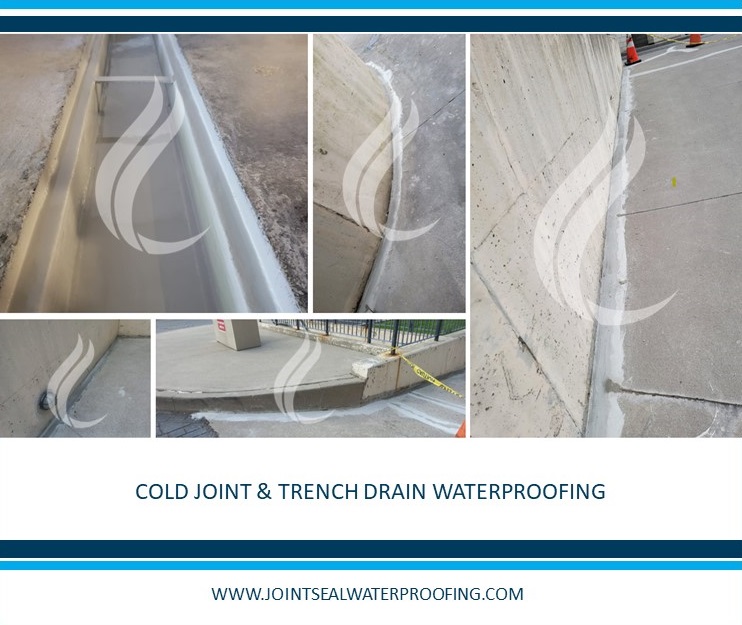
Cold joint repairs are usually measured in linear feet, and the runs are longer than people expect. On a commercial building on Railside Road in North York we repaired 30 linear feet of cold joint alongside 120 square feet of foundation wall waterproofing, with the cold-joint patch installed at a 45-degree angle and a polyurea membrane, fibreglass and industrial adhesive over it.
At a food-processing plant in Etobicoke the earlier phases ran to more than 350 linear feet of cold joint repairs and over 800 square feet of concrete patches, with the finished system tested at 1.85 MPa adhesion. We have been working at that plant since November 2020.
Worth noting how the square footage relates to the linear footage on a job like that. A foot of overlap each side means every linear foot of joint carries about two square feet of reinforced, coated surface — so a 350-foot run is a substantial area of work, not a thin line along a wall.
Is this the corporation’s responsibility or the unit owner’s?
A cold joint at a balcony slab or in a parking garage is virtually always common-element work and therefore the corporation’s responsibility, because the seam is part of the building structure rather than anything within a unit. That holds even when the water shows up inside a unit, on a ceiling or at the base of a balcony door.
Worth confirming against your declaration, since the boundary between unit and common element varies. But structurally, a cold joint is a construction seam in the building frame, and no unit owner has access to it.
What to do next
Look at the base of your garage walls, where the wall meets the floor slab, and follow the line. Staining, efflorescence, rust marks or damp patches along that horizontal seam are the signature — not a crack running randomly across a wall, but a straight line at a consistent height.
Measure it in linear feet, note where it’s wet, and that’s a scope. We handle parking garage concrete repair and cold joint patching across Toronto and the GTA, and a joint survey is normally the first thing we do on a leaking garage.
Common questions
Frequently asked questions
What is a cold joint in concrete?
A cold joint is the seam formed where fresh concrete was poured against concrete that had already started to set, leaving the two pours imperfectly bonded. It is created during construction rather than by damage or age, and it runs through the full thickness of the element. Because the bond across it is weaker than the surrounding concrete, it is a common water path.
Can a cold joint be sealed from the inside?
A cold joint can be repaired from the accessible side, which is how nearly all of this work is done in an occupied building, with no excavation and no access to the outside face required. The repair cuts into the seam, injects adhesive deep into it, then rebuilds and waterproofs the opening. Sealing only the surface does not work, because the seam continues behind it.
Why is a cold joint patch cut at 45 degrees?
A cold joint is cut open at a 45-degree chamfer rather than as a square notch, because the angled face gives the patch material a wider bonding surface and removes the sharp internal corner a membrane would otherwise have to fold into. A square corner concentrates strain on one line and is where a coating splits first.
How far past the joint does the waterproofing have to extend?
The fibreglass reinforcement runs about a foot onto the floor and a foot up the wall, so the repair carries across the corner rather than stopping at the seam. Reinforcement that ends at the joint just relocates the weak line a few inches away. The overlap makes the floor, the joint and the wall behave as one continuous surface.
How do I tell a cold joint leak from a crack leak?
A cold joint leak follows a straight horizontal line at a consistent height, usually where a wall meets a floor slab, while a crack leak wanders and often runs diagonally or vertically. Staining, efflorescence or damp along a straight seam at the base of a garage wall is the signature of a cold joint rather than a crack.
Is a leaking cold joint an emergency?
A leaking cold joint in a parking garage is not usually an emergency, but it is a continuous path for chloride-laden water to reach reinforcing steel, so it gets worse rather than staying stable. In an elevator pit the same seam is urgent, because water reaching elevator equipment can put the elevator out of service.
Are cold joints a construction defect?
Cold joints are a normal consequence of pouring concrete in stages and are not in themselves a defect, since every multi-storey building has them. What varies is how well the joint was prepared and treated at the time. A cold joint that leaks fifteen years on is usually showing the limits of the original detail rather than anything that went wrong later.
Related services & repair types