Project & Insights
What Is Polyurea Waterproofing? | Joint Seal
February 22, 2023
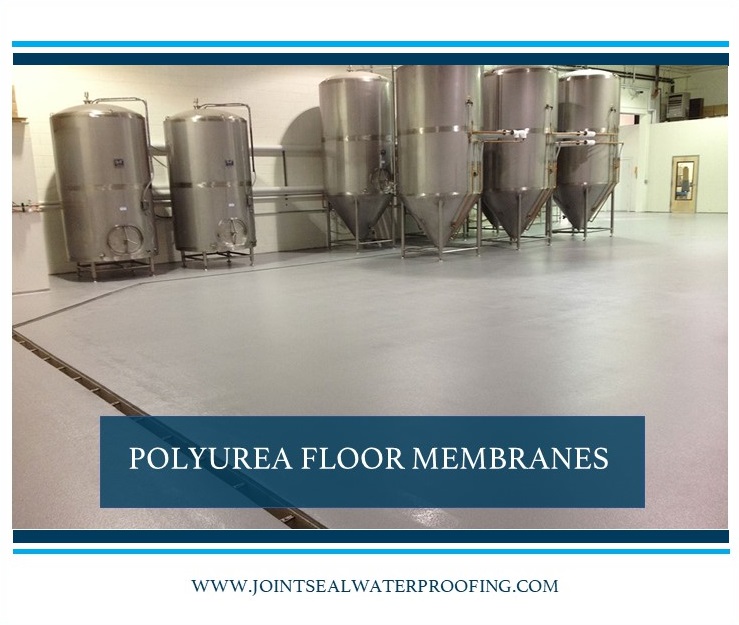
Polyurea is a spray- or roll-applied waterproofing membrane formed by the reaction between an isocyanate component and an amine blend. The property that matters on a repair job is that its molecular structure is moisture-insensitive: it cures in damp conditions, which is exactly the condition every leaking structure is in.
That single characteristic is why it is used on elevator pits, garage walls, balconies, podium decks and flat roofs, where the surface is rarely dry and never will be.
What polyurea does that other membranes do not
It cures wet. Most membranes need a dry substrate. On a below-grade wall or an elevator pit, dry is a temporary condition you buy with pumping and heat, and it ends the moment the crew leaves.
It goes on vertical and curved surfaces. Polyurea holds thickness on a wall, around a pipe, up a parapet and over a curved architectural surface without sagging. Sheet membranes and self-levelling systems cannot do this.
It cures fast. Rapid application is the reason a garage level or a pit can be turned around in a working day rather than a working week. Most repaired areas are back in service within 24 hours.
It is thermally stable, so it tolerates the range a Toronto structure sees between a February garage and an August roof deck.
Texture and thickness are adjustable. The same chemistry is specified thin and smooth on a wall and thick with traction on a walking surface.
It is a solvent-free, 100% solids formula and it is recyclable — which is what makes it usable inside occupied buildings, next to pool plant, and in medical and food facilities where solvent odour is not acceptable.
Where we use it
| Application | Why polyurea |
|---|---|
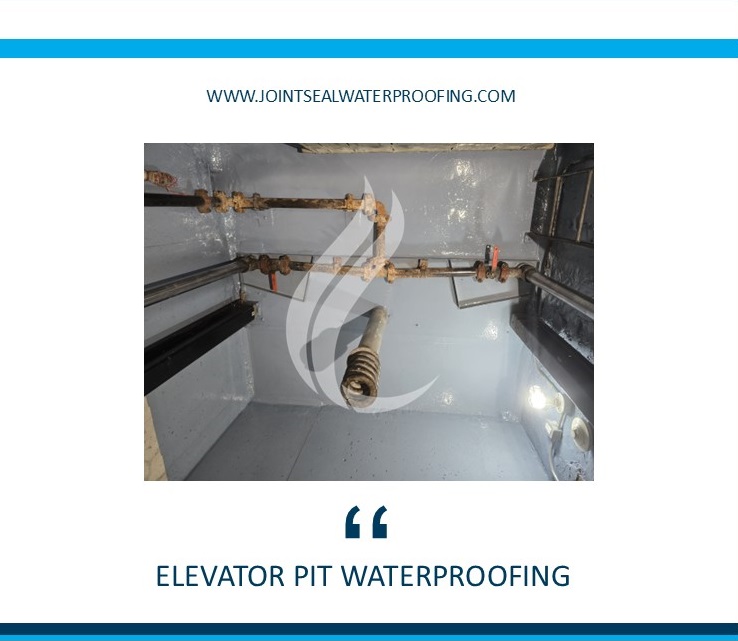
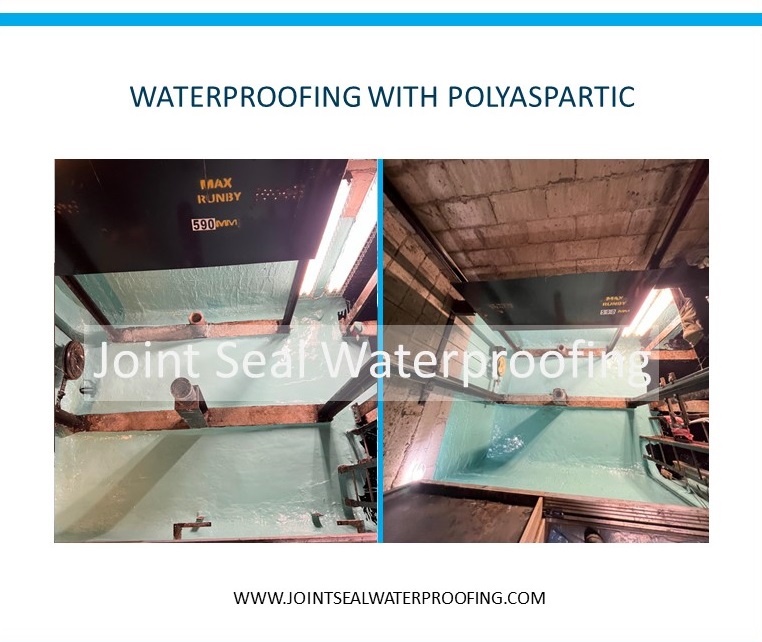
| Elevator pits | Cures in a damp pit; coats floor, walls and the piston housing detail |
| Garage walls and penetrations | Vertical application over parged repairs, moisture-tolerant |
| Balconies | Over geotextile, bridges movement, takes a polyaspartic top coat |
| Flat roofs and podium decks | Seamless, no laps to fail, applied over the existing build-up |
| Cold joints | Membraned across the joint rather than surface-sealed |
What polyurea is not
It is not a structural repair, and it is not a substitute for one. Applied over delaminated concrete, an open cold joint or a moving crack, it will follow the defect. On our jobs the surface repair and crack work happen first, with patches placed as thin as 5 mm against the two-inch minimum a conventional chip-out requires, and the membrane goes on afterwards.
It is also not a top coat in every application. On surfaces that see UV and foot traffic — balconies, walkways — a polyaspartic coating goes over it, both to protect it and to let the client choose a colour.
Service life
The materials we install carry a Ministry of Transportation Ontario rating for roughly a 25-year service life. That figure is a material service-life rating, not a warranty term, and it assumes correct preparation: mechanical cleaning back to sound concrete, a repaired substrate, and a membrane carried well past the detail it is protecting rather than stopped at its edge.
Preparation is the variable that decides real-world life. Polyurea bonded to a contaminated or unsound surface will lift no matter what the datasheet says.
The opinion, stated plainly
Polyurea gets specified for the wrong reason about half the time — because it is fast. Speed is a scheduling benefit, not a performance one. The reason to specify it is that it cures in the damp, holds thickness on a vertical surface, and has no laps or seams to fail. If a structure is dry, flat and accessible, cheaper systems will do the same job.
Related: polyurea waterproofing membranes · elevator pit waterproofing · balcony waterproofing · cold joint repair · documented projects · common questions
Common questions
Frequently asked questions
How long should elevator pit waterproofing last?
Properly installed elevator pit waterproofing generally holds around the ten-year mark, and we have had installations run well past five years even on pits where the walls were in poor condition to begin with. The variable is the substrate, not the coating — a pit with sound concrete lasts longer than one where the walls were already frail when we arrived.
How long before a thin patch can be walked on or driven on?
Polymer cement patches with Polyforce Plus adhesive cure in roughly four hours, comparable to how long conventional concrete takes to set, so most repairs take foot traffic the same day. Temperature affects it, and whatever coating goes over the patch usually governs the return-to-service date rather than the patch itself.
Can a contractor guarantee a leaking expansion joint will be fixed?
No method carries a 100 percent guarantee, including full excavation. A consulting engineer on one GTA condo board acknowledged this about his own top-side recommendation, because the exact locations of every membrane and joint crack are unknown before digging. Injection has the advantage of being repeatable at low cost if a joint needs a second pass.
Can polyurea be applied to a damp or leaking surface?
Yes, and that is the main reason it is specified. Polyurea has a moisture-insensitive molecular structure, so it cures in the damp conditions a leaking structure is always in. Active running water is different: that is stopped by injection first, and the membrane goes over the stopped leak.
Does polyurea have seams?
No. It is applied as a continuous liquid and cures in place, so there are no laps or joints to fail. That is the practical advantage over sheet membranes on complex surfaces such as pits, penetrations and parapets.
Does polyurea fix cracked or delaminated concrete?
No. It is a waterproofing membrane, not a structural repair. Over an open crack, a delaminated area or an unsealed cold joint it follows the defect and fails along it. The concrete repair is done first and the membrane goes on afterwards.
Related services & repair types