Project & Insights
Why are balconies on newer buildings already cracking?
September 10, 2026
By Valeriy, Application Specialist, JSW Waterproofing
Balconies on newer buildings crack because they were coated with a paint that seals moisture in rather than letting it out. Concrete holds water. Where the coating will not let that water evaporate, it freezes inside the slab through a Toronto winter and cracks it from within. On those balconies, bare concrete would have lasted longer than the coating that was applied to protect it.
What is a balcony coating actually fighting?
A balcony coating has to keep liquid water out of the concrete while letting the water already inside the slab evaporate away. Those are opposing jobs, and a product that only does the first one has built a vapour trap.
The failure runs in a predictable sequence. Moisture that cannot evaporate accumulates in the slab and in existing hairline cracks. It freezes, and ice takes up more room than water, so the crack widens. The next thaw lets more water in and the cycle runs again at every freeze-thaw event of a Toronto winter. The cracks lengthen and branch.
Why are newer buildings failing faster than older ones?
Newer buildings fail faster because a cheap non-breathable paint was specified on the balconies at construction. We are called to buildings not yet ten or fifteen years old showing crack patterns that should not appear for decades, and the pattern is consistent. Paint on the slab, moisture underneath it, cracks running out from there.
An older building with bare concrete balconies is often in better condition than a newer one with a coating, because bare concrete takes on moisture and then gives it back. Nothing traps it. That is not an argument for leaving balconies uncoated, since a proper coating outperforms bare concrete comfortably. It does mean the wrong coating is worse than none, which is worth saying plainly to a board weighing the cheapest quote.
How do you fix a balcony coated with the wrong product?
Fixing a badly coated balcony takes three steps in order: grind the coating off to bare concrete, seal the cracks with a thin-bodied permeating sealer, then recoat with a breathable system. The sealer we use at that stage is Polyforce Plus, which penetrates into the substrate rather than sitting on top of it. There is no shortcut and no coating over the top of the failed one.
The sealer has to be thin in structure so that it travels into the crack rather than bridging over it. A thick material sitting on the surface of a crack has sealed nothing. The final coat has to let vapour out of the slab while stopping liquid water getting in, and that is the property most cheap balcony paints do not have.
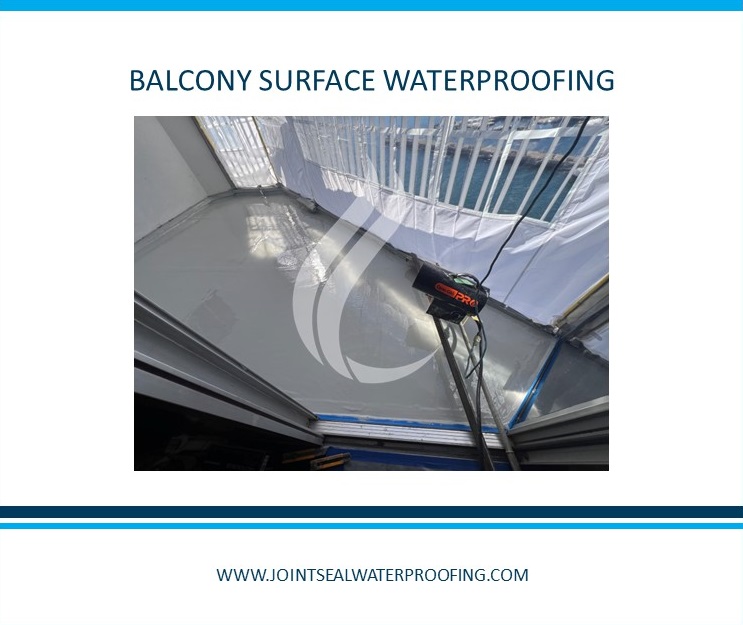
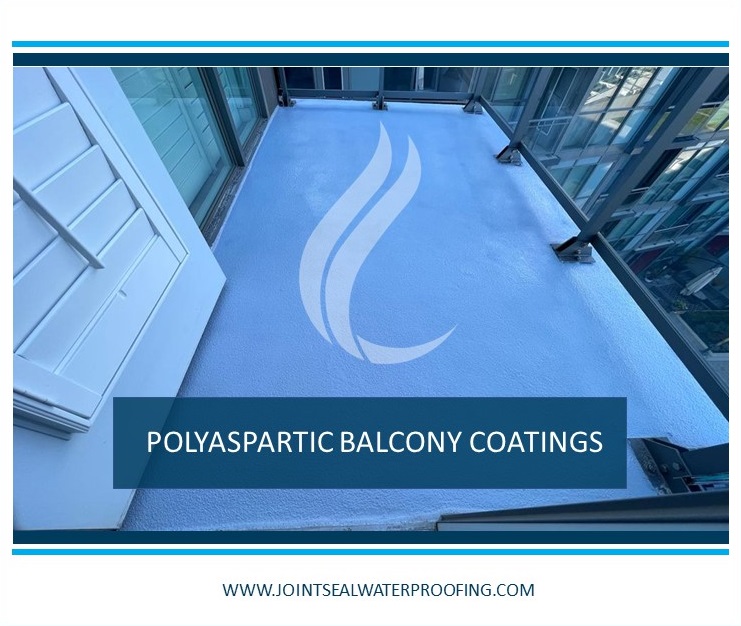
On a balcony restoration on Augusta Ave in Toronto the slab had cracks and a flat slope, so water was not draining off at all. Patches went in as thin as 5 mm, followed by a polyurea-based membrane and a polyaspartic coating with a sand broadcast. Slope matters as much as chemistry, because no coating compensates for water standing on a slab.
Does the same rule apply to a parking garage ceiling?
A parking garage ceiling needs a breathable coating for exactly the same reason a balcony does, because water travels down through the deck and has to be able to leave the slab. Epoxy is the worst choice in that position. It is an effective vapour barrier, which is the wrong property here, so moisture coming down through the concrete stops at it and stays.
Ordinary paint is not much better. It delaminates, wasting the money, and holds moisture while it lifts, though less thoroughly than epoxy does. Once the paint is scraped off, the slab dries out. The same logic protects the bases of the columns holding that ceiling up, where a lifting paint film holds salt water against structural concrete.
What should a property manager check before approving a coating?
Ask what the vapour permeability of the proposed system is, in those words, before approving any balcony coating. A supplier who can answer has specified a breathable system. A quote that only talks about waterproofing is describing half the job.
Then walk a few balconies. Coating lifting at the edges, blistering, or cracks radiating out from under a film that still looks intact all point to trapped moisture rather than surface wear.
Two more failure points belong in the same scope: the outer lip of the slab, which takes more damage than the field, and the joint where the balcony meets the wall. A programme that ignores either will be back on the reserve fund schedule early. More detail sits in our common questions on balcony repair, on the balcony services page and on the concrete surface repair page.
Start by walking three or four balconies on different elevations and photographing anywhere the coating has lifted or blistered. Sun-facing units fail first, so compare them against a shaded elevation on the same building. We will assess a representative sample and tell you whether the existing coating is the cause before anyone specifies a replacement.
Common questions
Frequently asked questions
Does a breathable membrane still keep rain out?
A breathable balcony coating allows water vapour to escape from the concrete slab while preventing liquid water from getting in. Concrete always carries some moisture, and a coating that blocks it in both directions traps that water where it can freeze and crack the slab from inside. Vapour permeability is the property to ask a supplier about.
Would bare concrete have lasted longer than cheap paint?
Bare concrete outperforms a non-breathable paint, because a bare slab dries out after every wetting while a sealed one cannot. This is not an argument against coating balconies, since a correctly specified breathable system lasts far longer than bare concrete, but a cheap impermeable paint shortens the life of the slab.
Can a new balcony coating go straight over the existing one?
No, where the existing coating is a non-breathable paint that has already trapped moisture. It is ground back to bare concrete first, because recoating over it seals the same water under a new surface. Where the existing system is sound and breathable, a recoat may be possible after adhesion testing.
Should we coat a parking garage ceiling with epoxy?
No. Epoxy on a parking garage ceiling acts as a vapour barrier on the wrong side of the slab, trapping moisture travelling down from the deck above. Use a breathable coating in that position, for the same reason a balcony needs one. Ordinary paint is little better, because it delaminates and holds water while it lifts.
How can you tell trapped moisture from ordinary surface wear?
Trapped moisture shows as blistering, coating lifting at the edges, or crack patterns radiating out from beneath a film that still looks intact. Ordinary wear shows as thinning and scuffing in traffic areas without lifting. If the building is under twenty years old and cracking, suspect the coating first.
Does a balcony coating need an engineer to specify it?
Not always, but on a multi-unit building it is worth having one name the vapour permeability requirement in the specification rather than leaving it to the lowest bid. That single line in a tender is what stops a cheap impermeable paint being substituted, which is the failure this article describes.
Related services & repair types