Project & Insights
Why does the outer edge of a balcony fail before the rest?
September 10, 2026
By Valeriy, Application Specialist, JSW Waterproofing
The outer edge of a balcony fails first because it is exposed on three faces while the rest of the slab is exposed on one. Water sheets over the lip every time it rains, wind drives rain against the vertical face, and the underside at the drip edge takes spray from below. That edge is where most of the long-term maintenance cost on a balcony programme is decided.
Where do balconies actually deteriorate?
Balconies deteriorate in two distinct places, and they are different problems with different fixes. The field of the slab develops cracks. Usually it is not falling apart, it starts as a crack and grows from there. The leading edge deteriorates faster and more visibly.
The lip is exposed on its top surface, its vertical outer face, and its underside where the drip edge is cut. It also holds freeze-thaw exposure that the sheltered part of the slab does not. And it is the part nobody looks at from the balcony, because seeing the face and the soffit means leaning over the railing.
How is a deteriorated balcony edge rebuilt?
A delaminated balcony edge is rebuilt by removing the failed concrete back to sound material and recasting the profile with a structural patching system, not by skimming over it. An engineer will normally have the damaged section knocked back first so the edge can be properly rebuilt.
This is structural patching rather than cosmetic patching, and the material matters more here than in the field of the slab. It should be a monolithic-bonding system carrying a corrosion inhibitor, because reinforcement near an exposed edge has usually been sitting in wet, salted concrete for years. A patch that only follows the edge geometry restores shape without restoring section, and the difference between an anchored patch and a bonded one matters more at an edge than anywhere else, because there is less surrounding concrete helping to hold it.
What protects the edge once it has been repaired?
A protective membrane wrapped around the edge is what stops the repair being repeated in a few years. Polyurea does this well. It is tough, it stays flexible, and it handles ultraviolet exposure and abrasion better than the alternatives on an exposed detail.
Coverage is the part that gets cut. Carry the trim over the last foot of balcony floor, down the vertical face, and a short distance back underneath to the drip edge. That treats three surfaces as one detail instead of a coating that stops where the floor stops. Wrapping those areas takes a significant share out of the recurring maintenance on a balcony programme, because they are the areas that take the most damage.
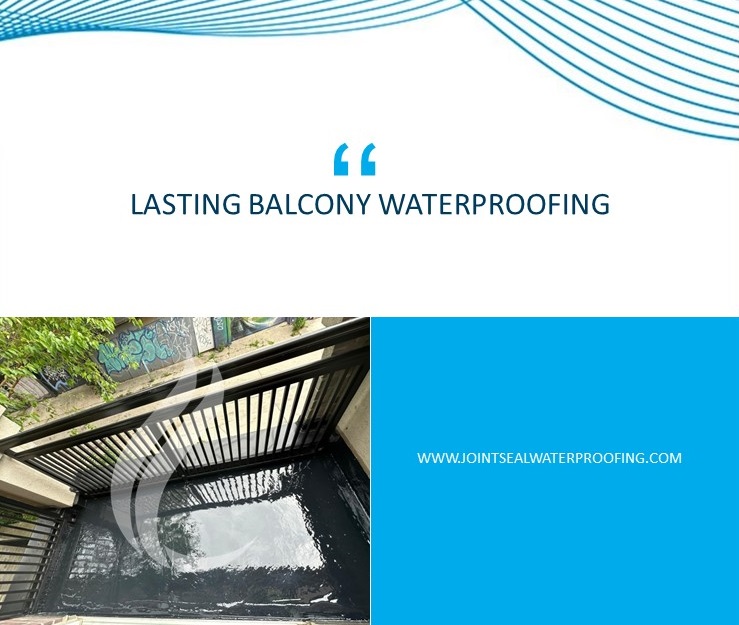
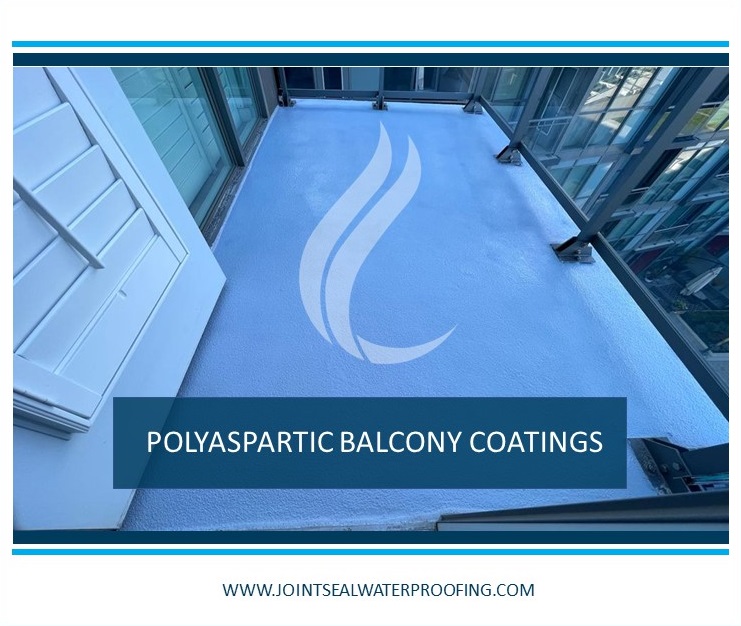
On a balcony restoration at a retirement residence on Martin Street in Milton we restored and waterproofed 19 balconies using an industrial-strength adhesive, fibreglass sheets, a polyurea-based membrane and a UV-resistant polyaspartic top coat with silica sand.
Why does the drip edge matter so much?
The drip edge is a groove cut into the underside of the balcony near the outer face, and it makes water fall clear instead of tracking back along the soffit. Where a coating stops at the vertical face and never reaches past that groove, water runs around the bottom corner and sits on unprotected concrete underneath.
That is why the trim continues a little way under the slab. It is a few inches of extra material, and it is the difference between the detail working and the detail dripping onto the balcony below.
What should a property manager look for on a balcony edge?
Inspect balcony edges from the balcony below or from ground level with binoculars, because the damage is on faces you cannot see from the balcony itself. You are looking for spalling on the vertical face, rust staining, a ragged bottom corner, or coating that stops short of the underside.
Where edges are sound, wrapping them during the next coating cycle is inexpensive insurance. Where they are already spalling, that is engineering scope, because exposed reinforcement at a balcony edge is a falling-material risk over an occupied area rather than a durability question.
Scope the coating on the field of the slab at the same time, along with the wall junction. Our balcony repair questions, the balcony services page and the polyurea membrane page cover how the phases are sequenced.
Start by standing on a balcony one floor down and photographing the underside and outer face of the unit above, on two or three different elevations. Rust staining or a ragged bottom corner in those photos tells you which balconies need an engineer before anything is budgeted. We will assess a representative sample and separate the maintenance from the structural work.
Common questions
Frequently asked questions
Is a spalling balcony edge dangerous?
A spalling balcony edge over an occupied area is a falling-material risk rather than only a durability problem, because the loose concrete sits directly above walkways, balconies or parking below. Where reinforcement is visible at the edge, have an engineer assess it rather than scheduling routine patching through the maintenance budget.
How far should a balcony coating extend over the edge?
A balcony coating should carry over the last foot of floor, down the full vertical face, and a few inches back underneath past the drip edge. Stopping at the vertical face lets water track around the bottom corner onto unprotected concrete, which is the most common reason an edge repair does not last.
What is a drip edge on a balcony?
A drip edge is a groove cut into the underside of a balcony slab near the outer face that makes water fall clear instead of running back along the soffit. It only works if it is intact and if any coating extends past it, which is why the detail is carried underneath rather than stopped at the face.
Can balcony edge repairs be done without a swing stage?
Often yes. On low-rise and mid-rise buildings the edge is reached from the balcony itself with the right access equipment and fall protection. Higher elevations and continuous facade work usually need a swing stage, which is why edge repair is normally scheduled alongside other facade work rather than run on its own.
Why does new flooring on a balcony hide the real condition?
Tile, vinyl and other surface finishes sit on top of the structural slab and conceal cracking underneath rather than stopping it. On a Milton retirement residence the cracks only became visible once old vinyl flooring came off, and they had to be filled before any membrane could be installed over them.
Is edge repair a maintenance item or a capital project?
Wrapping a sound balcony edge during a scheduled coating cycle is maintenance. Rebuilding an edge that has already delaminated, with exposed reinforcement, is a capital repair needing engineering involvement. The distinction is whether steel is visible, which is why the inspection matters before the budget is set.
Related services & repair types