Project & Insights
Why is the trench drain at the bottom of your garage ramp leaking into the level below?
September 9, 2026
By Valeriy, Application Specialist, JSW Waterproofing
A trench drain at the bottom of a parking garage ramp leaks into the level below because water gets out of the drain body — through cracks, through porous old concrete, or around the outside of the pipe where it drops through the slab — and tracks into the ledge beam carrying the trench. That beam runs across the underside of the ramp, so the first sign is almost always on the P1 ceiling rather than on the ramp itself. The repair is a waterproofing job inside the trench, not a plumbing job.
Everything that runs down a ramp ends up in that trench. The ramp slopes into the garage, so in heavy rain the whole surface drains to one line at the bottom, and that line takes vehicle traffic across it all day as well.
What does the leak look like from underneath?
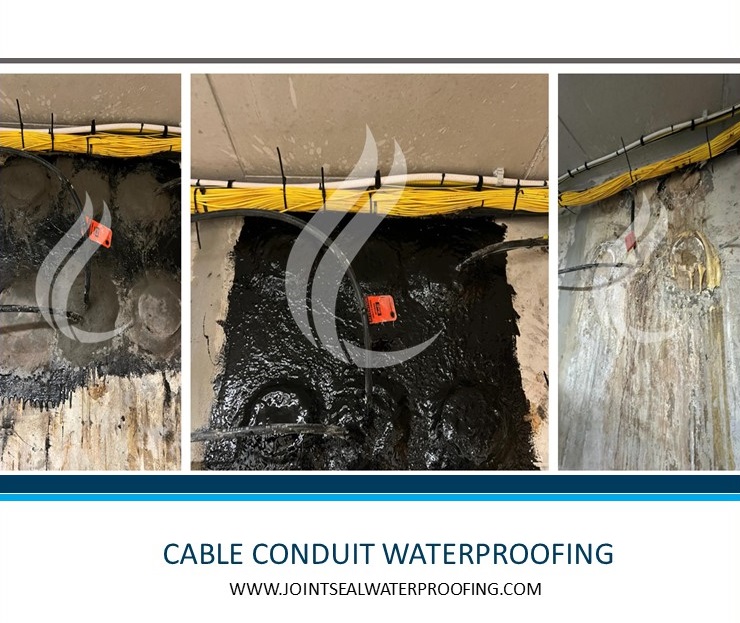
A leaking trench drain shows on the ledge beam below as staining, run marks, calcite deposits and, in rain, active dripping. It progresses in a recognisable order:
| What you see | What it means |
|---|---|
| Active dripping during and after rain | The trench is filling and water is escaping the drain body |
| Staining and visible run marks on the beam | Sustained flow, following a path you can trace back |
| White calcite build-up | Water carrying minerals out of the concrete over a long period |
| Cracking in the beam | The concrete is now being damaged, not just wetted |
| Delamination | Advanced — the beam surface is coming away and repair scope grows |
The last two are caused by the wetness itself. Once a ledge beam is cracking and delaminating, the trench drain above it has been leaking for a long time.
Where does the water actually escape?
Water escapes a garage trench drain in two places, and both need sealing or the repair only half works.
Through the trench body. Cracks in the trench floor and sides, or simply old porous concrete, let water pass straight into the structure below. Not every leaking trench has a visible crack — sometimes the concrete is old enough that it does not need one.
Around the outside of the drain pipe. This one gets missed. Where the pipe drops from the trench down through the slab, water runs down the outside of the pipe rather than inside it. The drain is working perfectly and leaking at the same time, which is why “the drain isn’t blocked” is not evidence that the drain is not the source.
How is a leaking trench drain repaired?
A leaking garage trench drain is repaired by cleaning it out, sealing the trench body with membrane, and making the drain pipe junction monolithic with the trench floor. The sequence:
- Remove the grates and inspect the inside. Nine times out of ten it has to be cleaned first, because there is enough debris in the trench that nothing can be seen or assessed.
- Clear the debris and open the drain so it runs freely.
- Find the water path. Look for cracks, and for the reasons water is migrating into the ledge beam. Sometimes it is cracks. Sometimes it is simply old concrete.
- Patch what needs patching inside the trench.
- Apply waterproofing membrane to the bottom, the sides and the edges of the trench, so nothing gets underneath it.
- Seal around the drain pipe. The area is ground and cleaned, a bonding agent goes down, then fibreglass reinforcement — about three inches out onto the trench floor, side to side across the trench, and a couple of inches down inside the pipe — then membrane coated over the top. Done properly the trench floor and the pipe become one continuous surface with no seam for water to find.
- Flood test. Run the drain and confirm both that it flows and that nothing reaches the beam below.
- Repair the ledge beam underneath. Clean up the staining and repair the concrete as needed, so the topside and the underside both show finished work.
Trench drains are typically six to eight inches wide, and the fibreglass is run from side to side across that full width rather than as a patch around the pipe.
That last step matters more than it sounds. Fresh membrane in the trench over an untouched, stained, cracking beam below tells a property manager nothing about whether the leak stopped — and leaves damaged concrete in place.
Does the ramp have to close?
No — a trench drain repair is done half at a time so the ramp never fully closes. The trench sits across the bottom of a ramp that has an entrance and an exit, and shutting the whole thing down is a serious inconvenience to residents. So the work is split.
Under traffic control, one side is closed — the entry, say — and that side’s trench is worked, usually about ten feet of it. When that half is complete it is opened, and the crew moves across and finishes the other side.
Each half runs one to two days depending on how much debris and cracking is found, with two days the practical maximum. The schedule is set by weather more than by traffic, because the membrane needs suitable conditions to go down. Vehicles are not a constraint on cure: cars cross the trench on the grating, so the membrane inside never sees a tyre.
Is this maintenance or a capital item?
A trench drain repair at the bottom of a ramp is normally maintenance-scale work, and it stays that way for as long as it is caught early. What escalates it is the beam. Water leaking into a ledge beam over years produces cracking, then delamination, then exposed and corroding reinforcement — and structural repair to a beam under a ramp is a different order of project than sealing the trench above it.
We have repaired exactly this at a mid-rise residential building on Maison Parc Crt. in Thornhill, where the trench drain at the bottom of the garage ramp was open to water infiltration along with the cold joints across both levels of the underground garage.
Related work sits on our parking garage waterproofing page, with the coating systems on our polyurea membranes page. If the staining on your ceiling runs in a straight line well away from any drain, the source may be a joint instead — why parking garage expansion joints leak covers that case. If the ramp above the trench is heated, anything cut into its surface needs the heating cables found and marked first, and cracks in that ramp need a different filler than caulking.
Next time it rains hard, go down to the level below the ramp and look at the beam running across the underside. Staining and white deposits there are the trench drain telling you what it is doing, months before anyone reports a leak.
Common questions
Frequently asked questions
What does staining on the ledge beam under a garage ramp mean?
Staining, calcite deposits and active dripping on the ledge beam under a garage ramp usually mean the trench drain above it is leaking. Water gets into the trench drain body through cracks or porous old concrete, or escapes around the outside of the drain pipe where it drops through the slab, then tracks into the beam. Left alone it progresses to cracking and delamination of the beam concrete.
Does the garage ramp have to close to repair the trench drain?
No — a trench drain repair at the bottom of a garage ramp is done half at a time so the ramp never fully closes. We take one side under traffic control, work the roughly ten feet of trench on that side, then open it and move to the other. Each half runs one to two days depending on debris and cracking, and weather rather than traffic sets the schedule.
How do you seal around a drain pipe that leaks on the outside?
Water escaping around the outside of the drain pipe is sealed by bonding fibreglass reinforcement across the junction and coating it with membrane so the trench floor and the pipe become one continuous surface. The area is ground and cleaned, a bonding agent goes down, the fibreglass runs about three inches onto the trench floor and a couple of inches down inside the pipe, then the membrane coats over it.
How do you know a trench drain repair actually worked?
A trench drain repair is verified with a flood test — the drain is run full and checked for flow and for any water reaching the ledge beam below. Ask to see the underside after the test, not just the trench. On our jobs the ledge beam below is also cleaned up and repaired, so the topside and the underside both show finished work rather than fresh membrane over old staining.
What does white powder around a concrete crack mean?
White deposits around a concrete crack are calcium carried out of the concrete by water moving through it, and the amount tells you the volume of flow. A heavy white bloom means a sustained, significant water supply behind that crack — not an occasional seep. It is the strongest visual signal that a crack is an active water path rather than a cosmetic one.
Related services & repair types