
Project & Insights
Cable & Pipe Penetration Waterproofing Toronto | Joint Seal
April 24, 2024
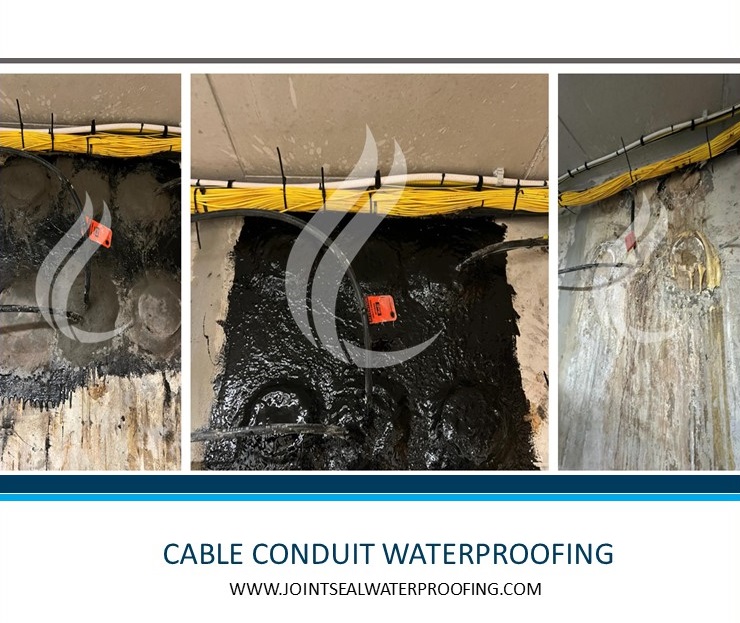
A cable or pipe penetration is a hole cut through a wall that was designed not to have one. Every conduit, sleeve and service entry through a below-grade wall is a deliberate breach of the waterproofing, and in most leaking garages we are called to, the penetration is the entry point rather than the crack the water finally shows up in.
The repair that lasts rebuilds the penetration as a bonded, membrane-protected assembly. Caulking around the conduit is not a repair; it is a delay.
Why penetrations leak when the rest of the wall does not
Three reasons, and they compound.
The annulus was never properly filled. The gap between the conduit and the cored or formed opening is packed with whatever was on site, and it shrinks.
The materials move differently. Steel or PVC conduit expands and contracts at a different rate from the concrete around it. Every thermal cycle works the interface a little looser, which is why a penetration that was dry for ten years starts weeping in a cold snap.
The patch is unbonded. A cement patch pressed into the opening with no adhesive and no reinforcement has nothing holding it to the parent concrete. It debonds, and the water path re-opens behind a repair that still looks intact from the garage side.
Rust-coloured staining below a penetration is the tell. It means water has been moving through long enough to reach reinforcing steel.
How we rebuild one
From inside the garage, without excavating the landscaping, driveway or podium above:
- Mechanical preparation. The surface is cleaned back to sound concrete with a mechanical wire brush. Preparation is the step that decides adhesion, and adhesion is the step that decides whether the repair lasts.
- Parging. The section of wall housing the conduit is parged to rebuild a continuous, sound substrate around the penetration rather than a ring of loose material.
- Membrane. A cold-applied polyurea-based waterproofing material is applied over the rebuilt section, carried well past the penetration onto the surrounding wall so there is no edge sitting at the point of highest stress.
Where the penetration is actively running under head, injection comes first: hydrophobic polyurethane resin (Joint Seal Flex) is injected to stop the flow before anything is built over it.
Why polyurea for this detail
Polyurea is formed from the reaction between an isocyanate component and an amine blend, and its molecular structure is moisture-insensitive — it cures in the presence of the damp that a leaking wall guarantees. It applies to vertical and curved surfaces, which is what a wall penetration actually is. It is thermally stable, it can be adjusted in texture and thickness, and it is a solvent-free, 100% solids formula.
It also goes on fast, which matters when the work is happening in a garage that stays open.
Excavation versus working from inside
The alternative is digging down the outside face of the wall to the penetration. That means removing whatever sits above it — landscaping, walkway, driveway, podium deck — and putting it back. Excavation is roughly 70% of the cost of a top-side repair before any waterproofing is installed. Working from the negative side avoids all of it.
There are cases where digging is the right answer, and they are worth naming honestly: a wall that has failed over a long run rather than at one point, or a penetration that has to be re-cored or re-routed. Both of those are different jobs.
A real example
At a shopping centre on Woodbine Ave. in Markham, we were brought in for a series of concrete repair and waterproofing scopes. The first was wall expansion joint repair in the parking garage. The second was a wall penetrated by a cable conduit that was leaking into the underground garage — cleaned with a mechanical wire brush, parged, then coated with a cold-applied polyurea membrane. No excavation, no interruption to the centre above.
The opinion, stated plainly
If a quote for a leaking penetration says “seal around conduit” and gives a price, ask what happens to the annulus and what the membrane laps onto. A repair that ends at the edge of the hole has put its weakest point exactly where the water is.
Related: pipe and cable penetration waterproofing · parking garage repair · polyurea membranes · cold joint repair · documented projects · common questions
Common questions
Frequently asked questions
Why do cheap concrete patches around a wall penetration fail so fast?
Ordinary bag concrete packed around a penetration has nothing bonding it to the existing wall and no waterproofing layer over it. It shrinks and cracks as it cures, and once groundwater sits against it under pressure the concrete degrades and the water finds its way back through. A repair like that commonly loses most of its effectiveness within a few months.
Does the landscaping have to be dug up to fix a leaking wall penetration?
Often not. Many leaking conduit penetrations are sealed from inside the garage — wire-brushing the wall, parging the section housing the conduit and coating it with a cold-applied polyurea material — with no digging at all. Excavation earns its cost mainly where a previous repair has already failed, because the condition of a buried penetration cannot be judged without exposing it. On grass the reinstatement is straightforward: the existing spoil goes back, topped with topsoil and seed.
How long does it take to excavate and seal a garage wall penetration?
About two days for a single penetration, including the excavation, the repair itself, and the cure time before backfilling. That assumes the penetration is roughly five feet down and the ground above is soft landscaping. Hard landscaping or asphalt over the excavation adds reinstatement time and cost.
How much does it cost to repair a leaking cable penetration in a garage wall?
In the range of $3,000 to $4,000 for a single penetration in soft landscaping across the GTA, covering excavation, the sealing build-up, backfill and reinstatement. Depth, access for a machine, and what sits above the penetration are the three things that move that number. Asphalt or hardscape above will push it higher.
How can a property manager tell the penetration repair was done properly?
Ask to see photographs of each layer before the excavation is backfilled. A sound repair shows loose material removed back to solid concrete, a bonding agent, a hydraulic waterproofing cement, then a cold-applied membrane with a fibreglass or geotextile reinforcing layer sandwiched inside it. If the only photograph is of finished concrete, there is no way to know what is underneath it.
What does rust-coloured staining on a concrete wall mean?
Yellow-brown staining around a crack means water has reached the rebar inside the wall and the steel is corroding. The staining is rust washing out through the crack. It usually indicates a narrower crack than a white-stained one, because it takes less water to corrode steel than to carry calcium out, but it points to a more structural problem.
Related services & repair types