Project & Insights
Why Is Excavation Two-Thirds of a Garage Deck Repair?
August 22, 2026
By Valeriy, Application Specialist, JSW Waterproofing
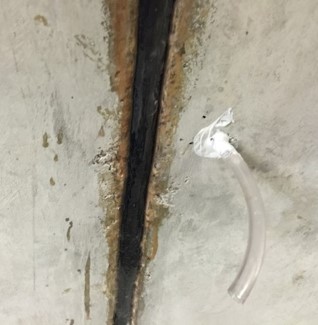
Read a top-side deck repair proposal as a landscaping project with a waterproofing step in the middle of it, because that is the shape of the money.
Roughly 70 percent of a top-side garage deck repair is excavation and restoration rather than waterproofing. The money goes to reaching the membrane and to putting back whatever was sitting on top of it. On a single leaking expansion joint, that means two-thirds of the budget is spent before anyone applies a waterproofing product, and the alternative — injecting the same joint from inside the garage — spends none of it.
Here is the sequence that produces that split.
What does a top-side repair actually involve?
A top-side repair of a garage deck means removing everything above the slab to reach the waterproofing membrane. On a condominium that is usually soil and grass, and often a playground, planters, or a park. Sometimes it is asphalt walkways and drive lanes.
The steps run in this order: excavate a large area, haul the material off site, blast the old membrane off the concrete, apply a new membrane, then restore the surface — the sod, the traffic topping, the paving, the decorations, all of it.
Exactly one of those six steps is waterproofing.
Why is the excavation always wider than the damage?
The excavation gets sized for uncertainty, not for the defect.
Nobody knows where a deck membrane failed until the deck is open. Water that gets under a debonded membrane runs along the concrete slab until it reaches an expansion joint, and on one downtown Toronto garage we measured roughly 20 feet between the crack in the membrane and the visible drip inside. Digging directly above the drip often misses the failure entirely.
So the area is opened broad enough to be confident of catching it. Every extra foot of width is excavation cost and restoration cost twice over — once to remove, once to replace.
What does removal and reinstatement look like at small scale?
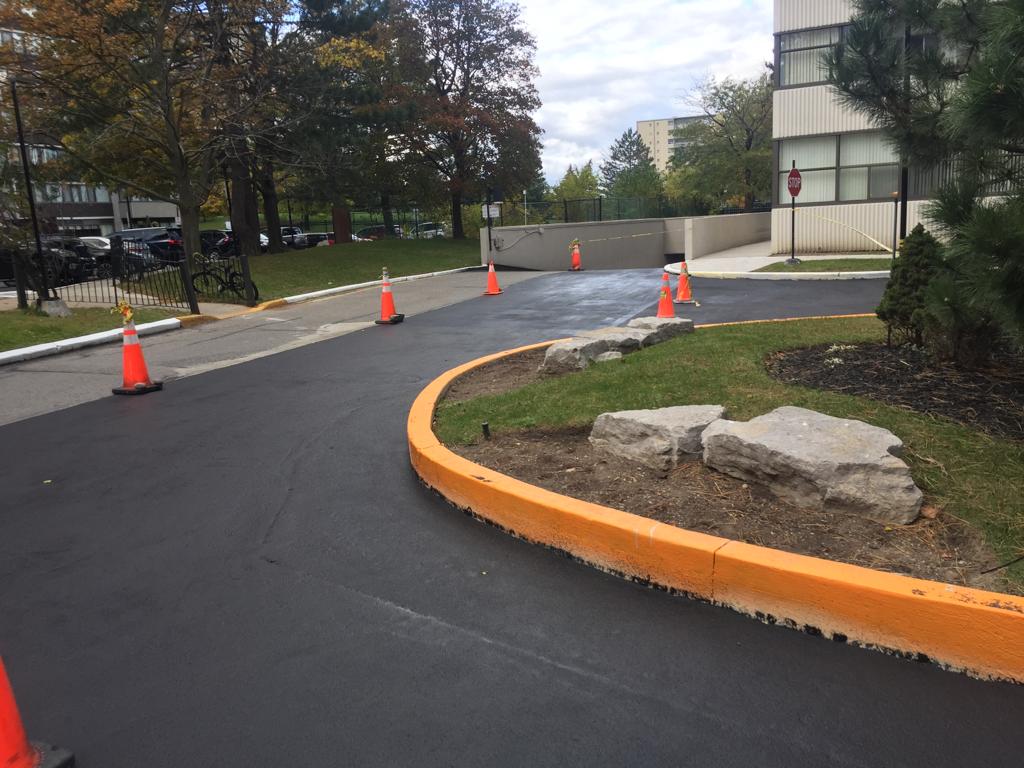
The proportions hold even on tiny jobs, which is the clearest way to see them. On a commercial building on Dundas St W in Toronto, a manhole in front of the building had deteriorated under constant traffic and weather. We cut a section five feet by five feet around it, removed the asphalt, soil and old brick base, poured a new concrete foundation set six inches lower than the original, then reinstalled the asphalt and surrounding materials.
The new foundation was the repair. The cutting, removal, hauling and reinstatement was most of the work, on a footprint of twenty-five square feet. Scale that geometry up to a deck and the ratio does not improve. The full record is in the manhole restoration project.
What does the disruption cost that the invoice does not show?
A top-side excavation on one joint is usually a five- to six-month project with the area fully closed. The landscaping is gone for that period. If there is a playground on the deck, it is gone for the season, and residents live beside heavy construction for most of a year.
The same joint injected from below is about a two-day job. The garage stays open, roughly ten parking spots are vacated so nothing is dripped on, and cars keep moving. That comparison is set out in full in negative-side injection versus digging up the garage deck.
When is the excavation worth paying for anyway?
When the excavation is being done for another reason. If the membrane is failing broadly across the deck rather than at one or two joints, or the landscaping above is scheduled for redesign, the digging cost is already committed and the new membrane rides along with it. That is good sequencing.
Our opinion is narrower than the usual argument: excavation is not the wrong method, it is the wrong unit. Buying 70 percent landscaping to fix one 20-foot joint span is a scope mismatch, and it is worth naming as one before a board votes on it.
How do you tell which case you are in?
Count the leaks. One or two joints staining in an otherwise dry ceiling points to localised membrane failure and a joint repair. Staining in many unrelated places across the P1 ceiling points to a membrane at the end of its life, and that is the deck-replacement conversation.
The type of joint matters too, because a joint with nothing buried above it never needed excavating in the first place — we have set out the difference between mid-slab and top-slab joints.
Book an inspection and we will tell you how much of the deck is actually involved before anyone prices digging it up.
Book a JSW inspection · More on traffic surface repair, expansion joint repair and polyurea membrane systems. Our FAQ covers what excavation includes.
Common questions
Frequently asked questions
What share of a top-side deck repair is excavation and restoration?
About 70 percent of a top-side repair is not waterproofing at all. It is excavating a wide area, hauling the material away, blasting off the old membrane, then restoring the sod, traffic topping, playground, or asphalt that was on top. Injection skips all of that by working from inside the garage.
Why does a top-side repair have to be excavated so wide?
Because nobody knows exactly where the membrane failed before the deck is opened. Water travels under a debonded membrane before exiting at the joint, so the breach can be 20 feet or more from the visible drip. The excavation is sized to be sure of catching it rather than to match the damage.
How long is the deck closed for a top-side excavation?
A top-side excavation on a single joint is usually a five- to six-month project with the area fully closed. Everything on the deck above comes off and goes back, so a playground or a park is out of service for the season rather than for a few days.
When is excavating the deck still the right decision?
Top-side excavation makes sense when the deck membrane is failing broadly rather than at one or two joints, or when the landscaping above is being replaced anyway. If the excavation cost is already being spent for other reasons, redoing the membrane at the same time is sensible. For a localised joint leak, it rarely is.
Does the landscaping above have to come out to stop a joint leak?
In most cases, no. Negative-side injection seals the joint from inside the parking garage, with no excavation of the soil, playground, or asphalt on the deck above. A typical 20-foot joint span takes about two days and requires roughly ten parking spots to be vacated, rather than a full closure.
Related services & repair types