Project & Insights
Why Does the Membrane Over a Garage Joint Come Unstuck?
August 22, 2026
By Valeriy, Application Specialist, JSW Waterproofing
Nobody punches a hole in a garage deck membrane. It comes unstuck. There are only two ways that happens, and they run on completely different clocks.
A garage deck membrane comes unstuck one of two ways: slowly, through freeze-thaw cycling and gradual loss of adhesion in areas nothing ever drives over, or quickly, through hydraulic pounding under cracked asphalt where there is traffic. Both end in the same place. Water gets between the membrane and the concrete, runs sideways along the slab, and exits at the nearest expansion joint. The joint is where you see it. The joint is not where it started.
That distinction is the whole reason garage deck leaks get misdiagnosed.
What are the two ways a deck membrane loses its bond?
A membrane over a parking garage deck is a bonded layer. It works because it is stuck to the concrete. Debonding is therefore the failure, and it arrives by two different routes.
The slow route runs under landscaping — soil, sod, a park, a playground. Nothing drives there, so there is no mechanical access to the area either, and the membrane simply cycles through Toronto winters until adhesion gives up in patches.
The fast route runs under asphalt where cars and delivery vehicles pass. That one is measured in seasons rather than decades.
How does freeze-thaw pull a membrane off a slab?
Freeze-thaw debonding under landscaping is unspectacular and that is why it gets missed. Water sits in the soil above the membrane. It freezes, expands, thaws, drains, and does it again dozens of times across a GTA winter. Each cycle works at the bond line between membrane and concrete.
Nothing on the surface changes. There is no crack to photograph and no pavement to inspect, because the failure is under a garden. The first evidence is usually a drip in the ceiling of P1, years after the debonding began.
How does cracked asphalt above break the membrane below?
Cracked asphalt is the aggressive version. Water collects in the crack, and each passing tire pressurises it into a hydraulic pocket with nowhere to escape. That repeated impact breaks the asphalt apart from below and hammers the membrane beneath it.
The crack itself is not the damage. It is the route the pressure travels. Which is why the arithmetic on crack sealing is so lopsided: surface crack sealing over a deck runs in the range of five dollars a foot, and repairing the membrane and concrete after the crack has worked through runs in the range of three hundred dollars a foot. We have set that comparison out in full in what a crack in your asphalt actually costs.
Do expansion joints leak on their own?
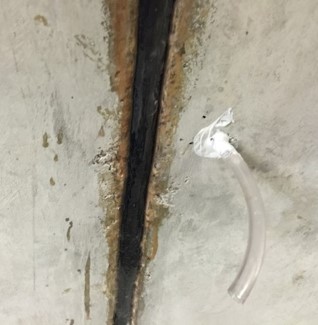
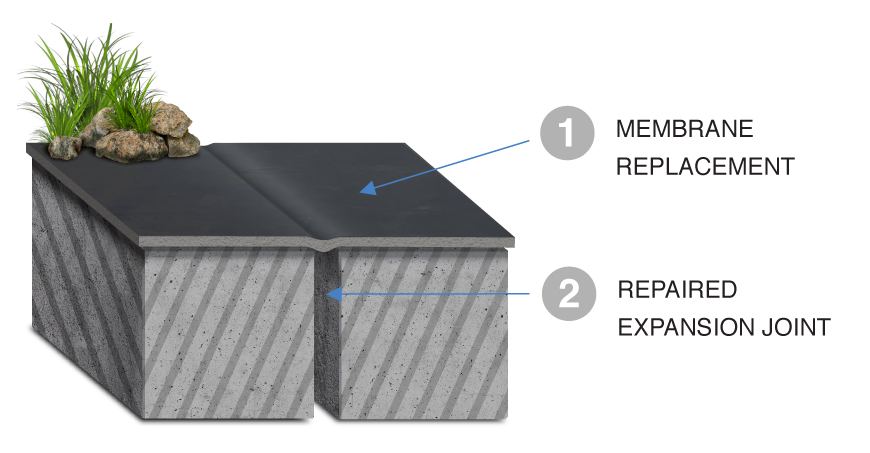
Expansion joints do not leak for no reason. This is worth saying plainly, because a leaking joint gets treated as an aged component that has reached the end of its life on its own schedule. It has not. Something above it broke the membrane first, and the joint is the low point that collected the result.
Our opinion, after years of these repairs: sealing the joint and leaving cracked pavement above it untouched is half a repair. It buys time. It does not remove the cause.
How far does the water travel before you see it?
Further than people expect. Water under a debonded membrane runs along the concrete until it reaches a joint, and on one downtown Toronto garage we measured roughly 20 feet between the crack in the membrane and the drip inside the garage.
Twenty feet is enough to make excavation directly above the drip a coin flip. It is also why injecting from below works — the resin follows the water’s own path backwards rather than needing the breach located from above.
What does the alternative to excavation look like on a real deck?
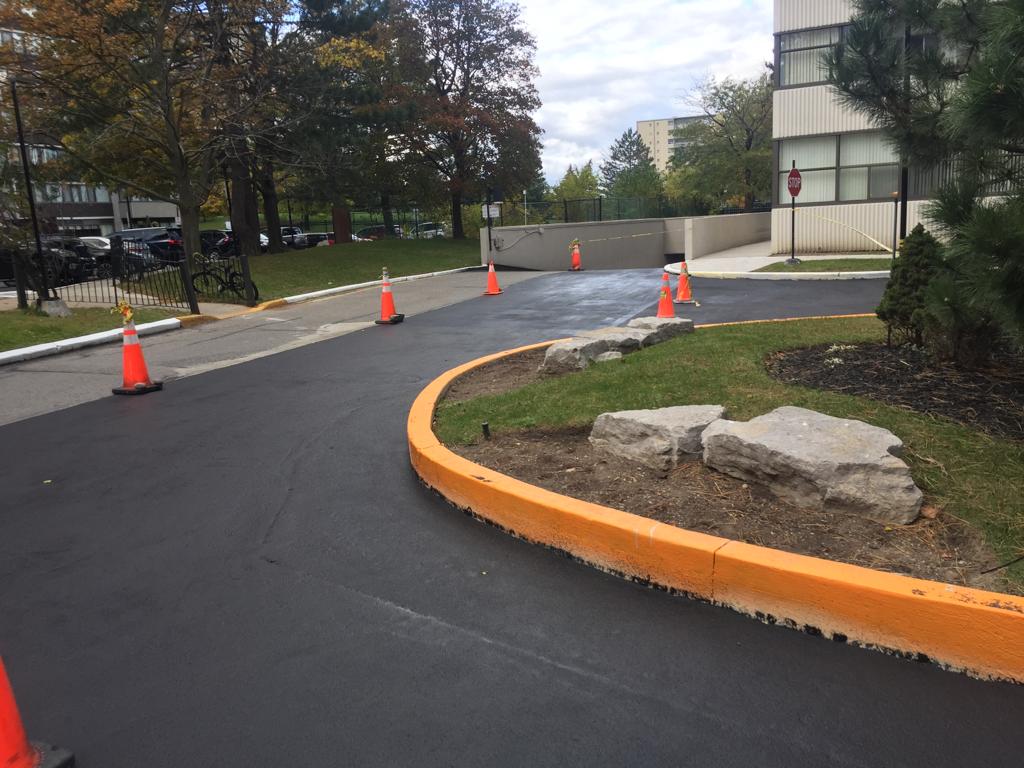
On a high-rise residential building on Antibes Dr in Toronto, the asphalt on the exterior parking deck and driveway had deteriorated, and the traditional fix meant tearing out the asphalt, installing a new membrane and repaving. Instead we overlaid the existing surface: pressure-washed it, filled the cracks with cold-applied polyurea, primed with a water-based epoxy primer, then installed two layers of polyurea-based membrane with an aluminum oxide broadcast in the second. Roughly 30,000 SQF went down in the first stage, in August, with a further 8,000 SQF in stage two. The full sequence is in the exterior parking deck and driveway record.
Materials like these are tested to MTO standards for a service life in the region of 25 years. That is a material service-life rating, not a promise about a building.
What should you check before budgeting a joint repair?
Walk the deck above every joint that leaks and note what is on it. Grass and soil point to slow debonding. Cracked asphalt points to a source you can seal for a few dollars a foot before it becomes a few hundred. Then look at whether the joint below is a top-slab or a mid-slab joint, because that changes the cost more than anything else you can record.
Book an inspection and we will tell you which of the two failure paths your deck is on.
Book a JSW inspection · More on parking garage repair, polyurea membrane systems and expansion joint repair. Our FAQ answers the questions boards ask first.
Common questions
Frequently asked questions
Why does a waterproofing membrane come unstuck from a garage deck?
Two paths account for most of it. Under soil, sod or a playground, where nothing drives over the deck, the membrane loses adhesion slowly through freeze-thaw cycling. Under asphalt with traffic on it, cracked pavement pounds the membrane hydraulically and the bond fails much faster. In both cases water then runs between the membrane and the slab.
How does cracked asphalt above a garage deck break the membrane below?
Water collects in the crack, and each passing tire pressurizes it into a hydraulic pocket with nowhere to escape. That repeated impact breaks the asphalt apart from below and hammers the membrane beneath it. The crack itself is not the damage — it is the route the pressure travels.
Do expansion joints ever leak without a failure above them?
Expansion joints do not leak for no reason. Something above has to break the membrane first, and where a joint runs near paved areas cracked asphalt is a common cause. Sealing the joint without sealing the asphalt treats the symptom while the source keeps working.
How far can water travel under a debonded deck membrane?
Water that gets under a debonded deck membrane runs along the concrete slab until it reaches the expansion joint, then exits there. On one downtown Toronto garage we measured roughly 20 feet between the crack in the membrane and the visible drip inside. This is why digging directly above the drip often misses the failure.
When should the asphalt above a parking garage be inspected?
After the spring thaw. Freeze-thaw cycling over a Toronto winter opens cracks to their widest and the damage is fresh and visible. Sealing before the summer means traffic is not pumping water through open cracks for the busiest months of the year.
Related services & repair types