Project & Insights
Why is water running out of the electrical conduit box in our garage ceiling?
August 18, 2026
By Valeriy, Application Specialist, JSW Waterproofing
Valeriy — Application Specialist, Joint Seal Waterproofing — fifteen years injecting expansion joints across the GTA
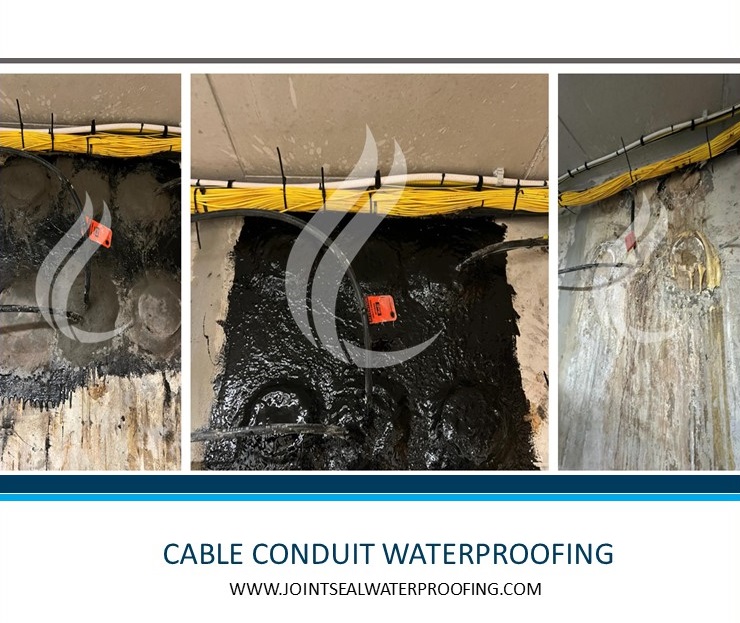
Water running out of a concrete conduit box in a parking garage ceiling usually did not come through the deck above. It came in at the point where the electrical cables pass through the exterior garage wall, and then travelled along the inside of the conduit box until it found somewhere to fall out. On a Vaughan condominium we inspected this month, the entry point and the drip were about 30 metres apart, with a further 70-metre cable run beyond that.
That distance is the whole problem. The property manager is standing under a curtain of water in the middle of P1, and the actual breach is buried five feet underground on the other side of the wall.
How water gets into an electrical conduit run in the first place
High-voltage cables run from a hydro vault to the building underground, and where they reach the garage they pass through the exterior wall. At that penetration the cables are usually encased in a concrete box built around them. Inside the garage, the run continues as a boxed-in concrete channel — on the job we inspected, roughly one foot by one foot, running about 30 metres across the P1 ceiling.
That box is not a drainage detail. Nobody designed it to carry water. But if the seal at the wall penetration has failed, groundwater pushes through the gap around the cables and the box becomes the path of least resistance. It behaves like a gutter, running downhill on the inside until it reaches a low point.
The cables themselves are worth understanding here. Between the vault and the wall they are often not in conduit at all — just black rubber-coated high-voltage cable in the ground. There is no sleeve to seal against. Everything depends on the concrete encasement at the wall, which is exactly the detail most likely to have been repaired badly.
How to rule out the slab above before anyone starts digging
Check whether the staining is confined to the conduit box or spread across the ceiling. On the Vaughan job the P1 ceiling was clean everywhere except along the box itself — no efflorescence, no rust staining, no damp patches anywhere on the underside of the deck above. That is what rules out the garage slab. A failing deck membrane leaks in more than one place, because a membrane fails over an area.
The other end of the check is the hydro vault. We measured the depth in the vault and found it dry, which eliminated the obvious theory that the vault was filling and feeding the conduit run backwards. A dry vault and a wet conduit box points in one direction: the water is entering somewhere between them, at the wall.
This kind of tracing matters because garage water rarely exits where it enters — the same principle that sends crews excavating over a drip and finding intact membrane underneath.
Why the middle of the run drips worst
Where the box sheets rather than drips is usually the low point of the run. On the Vaughan garage, the superintendent described water sheeting across the drive aisle and two parking spots during heavy rain, then dripping more lightly for roughly ten metres in each direction along the rest of the box. That gives you about ten metres of heavy discharge in the centre of a 30-metre run.
Nothing visible confirmed the low point on this job — no sag, no droop, nothing that would tell you by eye. It is an inference from where the water concentrates, and it is a reasonable one, but it is not something you should let a contractor present as a measured fact.
What to do about the cars while the source is being traced
Move the vehicles and close off the bays. The management company at the Vaughan building had already relocated the affected residents into visitor parking and taped off the drive aisle section before we arrived, which stopped further staining immediately. That is the right first move, and it costs nothing.
It does not fix anything. Water still runs into the garage every time it rains heavily, and the concrete around the conduit box keeps getting saturated. But it takes the resident complaints out of the equation, which buys the time needed to open the ground and repair the source properly rather than slapping something over it.
On the question of who pays for a car that has already been stained: most property management companies direct the owner to their own auto insurance, and some will cover the deductible. It genuinely differs between corporations. Worth settling with your insurer before the second complaint arrives.
Why nobody finds this until a resident does
Garage leaks are almost never spotted by the superintendent or the property manager. They are reported by a resident, and by then the water is landing on a car. Once someone is standing in the parking garage taking photos of their own hood, you have lost the ability to schedule the repair on your own terms.
The fix is not complicated: a regular walkthrough of the garage, and a condition assessment that puts every water path in the building on one list. Every three months, six months or annually depending on the age and condition of the garage and how much appetite the board has. This failure mode is common enough that it turns up in ordinary buildings for ordinary reasons — at a mid-rise condo on Heintzman Street in Toronto an internet cable conduit was leaking into the underground garage at a building corner, and at a high-rise on King Street in Toronto the garage leaks started only after a cable conduit was run through the structure. A conduit installed by somebody else is a water path nobody inspected.
What this costs to fix properly
Repairing the source means excavating to the penetration — roughly five feet down on this job — stripping out the failed repair, and rebuilding the seal as bonded concrete surface repair with a membrane-reinforced layer over it, rather than a slab of bag mix. Two days and $3,000 to $4,000 is a realistic range for a single penetration in soft landscaping, where reinstatement is spoil, topsoil and seed. The full method is set out in our guide to sealing a cable penetration in a garage wall.
If water is coming out of a conduit box in your garage ceiling, do two things this week: photograph the staining along the full length of the box while it is dry, and check whether the ceiling anywhere else on that level is stained. Those two observations tell an inspector more than a description of the drip ever will. Our team inspects parking garages across Toronto and the GTA and will trace the source before anyone quotes a repair.
Common questions
Frequently asked questions
Why does the leak appear in a different place than where the water gets in?
Water that gets under a debonded deck membrane runs along the concrete slab until it reaches the expansion joint, then exits there. On one downtown Toronto garage we measured roughly 20 feet between the crack in the membrane and the visible drip inside. This is why digging directly above the drip often misses the failure.
How can you tell if garage water is coming from the slab above or tracking in from outside?
Look at where the staining stops. If the water marks are confined to one element — a conduit box, a pipe chase, a single joint line — and the rest of the P1 ceiling is clean and dry, the water is being carried in from outside rather than coming down through the deck. A slab-above failure almost always leaves staining in more than one place.
Who pays if water in the parking garage damages a resident's car?
In most GTA condominiums the resident is directed to claim on their own auto insurance first, and some management companies will cover the deductible as a goodwill measure. Responsibility varies between corporations and between management companies, so it is worth confirming the position with the property manager and the corporation's insurer before residents start asking.
What should we do with the parked cars while we wait for a garage leak repair?
Relocate the affected vehicles and tape off the bays underneath the leak. On a Vaughan condominium garage we inspected this month, the management company had already moved the affected residents into visitor parking and closed off the drive aisle section, which stopped further staining while the source was traced. It costs nothing and removes the complaint that drives everything else.
How often should a condo parking garage be inspected for leaks?
A walkthrough every three to twelve months, set by the age and condition of the garage. Most garage leaks are reported by a resident rather than found by the superintendent or property manager, which means the problem is already dripping on someone's car by the time anyone hears about it. A scheduled condition assessment moves that discovery forward.
Related services & repair types