Project & Insights
Does your condo pool have to be drained to repair it?
August 18, 2026
By Valeriy
Valeriy — Application Specialist, Joint Seal Waterproofing — concrete pool refurbishments across the GTA and Miami
It depends entirely on where the damage is. A crack that goes through the slab means the pool comes down all the way, because you cannot open a crack against the water pressure behind it. A damaged area on a wall usually means draining only to just below the damage. A patch on the floor means a full drain — but the water starts going back in fifteen minutes after the patch is finished.
Most property managers assume any pool repair means an empty pool for weeks. Sometimes it does. Often it doesn’t, and the difference is worth knowing before you approve a scope, because draining a condominium pool costs the corporation far more than the invoice from the contractor.
What does draining a pool actually cost the building?
Draining a condominium pool carries three costs, and the water bill is only the first one. The amenity is out of service for the whole building, which is the cost residents notice. Refilling runs into real money — on a mid-size condo pool, ten to twenty thousand dollars of water.
The third cost is the one nobody mentions, and it is the reason we do not drain a pool casually. A full pool is a structure under load. The pool is like a balloon under tension, held expanded by a tremendous amount of water. Take the water out and the shell contracts. Put it back and it expands again. Both the drain-down and the fill are done deliberately slowly to keep that movement as small as possible — a drain-down alone takes twenty-four hours, sometimes longer, and going faster is not a favour to anyone. But the cycle still happens, and every cycle is one more than the shell needed.
So the question is never just “can it be fixed.” It is “how far down does the water actually have to go.”
When does the pool have to come all the way down?
A crack that passes through the slab or wall requires a completely empty pool, with no exceptions. The repair starts by opening the crack out with a chipping gun, and you cannot do that with water behind it — the pressure comes straight through the moment the crack is opened. Water is heavy, and a pool wall holds a lot of it.
The other case is a full resurfacing, where the existing finish has reached the end of its life and the whole interior is being taken back to bare concrete. That is a different scale of job, covered in how long a pool refurbishment actually takes.
Condominium pools have one advantage here that a backyard pool does not. Nearly every condo pool is a suspended pool — even the ones that read as basement pools. There is a crawl area underneath holding the pool mechanical room, which means the underside of the slab and the outside face of the walls can be reached. On a through-slab crack we work it from both faces: open it from inside the pool and from the mechanical room, inject epoxy, then parge and cover the line with a six-inch band of woven fibreglass bonded in epoxy.
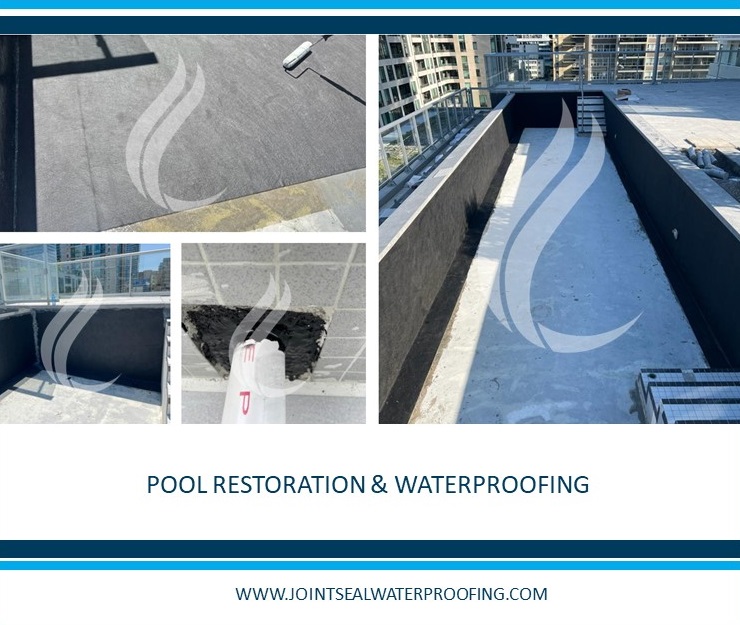
On an exterior infinity pool on the sixth floor of a residential building on Erskine Avenue in Toronto, the walls had cracked as the concrete aged and the drainpipe penetrations were open to infiltration. That one took crack repair, geotextile, and three coats of a cold-applied polyurea-based membrane with an aliphatic top coat for UV. Different build-up from an indoor pool, same principle: you cannot do any of it against standing water.
When can you get away with a partial drain?
A localised repair on a pool wall usually needs only a partial drain — down far enough to expose the damaged area and no further. If the damage sits three feet below the coping, the water comes down four feet. The rest of the pool stays where it is, the shell never fully unloads, and the refill is a fraction of a full one.
This is the single biggest cost lever on a pool repair and it gets missed constantly, because the default assumption on both sides of the conversation is that a pool is either full or empty.
A floor repair is the harder case. There is no way to expose a floor without taking the water off it, so a floor patch means a full drain. What softens it is the refill timing.
| Where the damage is | How far the water goes down | When the refill starts |
|---|---|---|
| Through-slab crack, wall or floor | Fully empty | Next day, after the repair cures |
| Localised area on a wall | Partial — just below the damage | On completion of the repair |
| Localised patch on the floor | Fully empty | Fifteen minutes after the patch |
| Full resurfacing | Fully empty | Same day the finish goes on |
Why does a marbelite patch get flooded fifteen minutes later?
Marbelite has to cure under water, so on a floor patch the fill starts almost immediately — about fifteen minutes after the last trowel. Marbelite is the cementitious quartz-and-silica finish most condo pools have; Diamond Brite is one brand of it. The rule is the same at every scale: on a full resurfacing, the pool is filled the same day the finish is applied. Leave it dry overnight and the finish cracks.
That rule cuts in the building’s favour on a partial repair. A floor patch that is under water within the hour is a pool that was empty for a day, not a fortnight.
What happens if a drained pool sits open?
A drained pool with an epoxy coating should not be touched by anyone, because physical contact with the dry wall can stain it permanently. This one surprises people, and it cost a building on Bayview Avenue a recoat.
The pool was drained. Someone wiped a wall down with a towel — a helpful thing to do, on the face of it. The wiped areas turned yellow. The walls nobody touched stayed clean. It is a reaction between the bromine in the water, the epoxy coating and oxygen, and the contact is what sets it off. It does not come out. The wall had to be recoated.
Two qualifiers. Epoxy coatings on pools are uncommon — in years of this work I have done exactly one. And on a full resurfacing it does not matter at all, because the coating is being ground off anyway. It matters on a partial repair, where the existing finish is staying. If your pool is drained for a localised repair, the instruction to site staff is simple: nobody touches the walls.
What most people get wrong
The assumption that fixing a leak means emptying the pool. It often doesn’t, and even when it does, the empty period is usually far shorter than the number in someone’s head.
The other one, from the other direction: assuming a hairline crack can be left. They are called haircuts in the trade because that is what they look like — fine surface cracks that don’t pass through the concrete. They don’t leak, so they get deferred. But water works into them slowly, the concrete around them deteriorates, and eventually you get a crack that does go through the slab. A haircut is a cheap repair from inside the pool with the water partially down. A through-slab crack is a full drain, both faces, and a fibreglass detail.
What to do about it
Before you approve any pool scope, ask the contractor one question: how far down does the water have to go, and why. If the answer is “all the way” for a repair on a wall, ask what is stopping a partial drain. If the crack passes through the slab, the answer is legitimate. If it doesn’t, you may be paying for twenty thousand dollars of water and three weeks of a closed amenity that the job never required.
And get into the pool mechanical room with a flashlight before anyone quotes. The underside of a suspended pool slab tells you more about its condition than the finished surface does — which is exactly why nobody can price a pool repair honestly until the coating comes off.
Book an inspection and we will tell you what scope your pool actually needs — including whether it can be done without draining it — in a form you can take to the board.
More on swimming pool repair and waterproofing, concrete surface repair and crack repair, or read why a pool leak shows up in the mechanical room.
See the work. Pool repair and waterproofing projects: Complete Restoration and Waterproofing Solutions for Swimming Pools · Waterproofing Solutions for Pools. More in our projects.
Common questions
Frequently asked questions
How bad does a pool crack have to be before it needs repairing rather than monitoring?
Any crack in a condominium pool shell is worth repairing, including hairline cracks that are not leaking. Fine surface cracks let water into the concrete slowly, which deteriorates it from the inside and eventually produces a crack that passes right through the slab. A hairline crack is repaired from inside the pool with a partial drain; a through-slab crack needs the pool fully empty and work from both faces.
Can a pool repair wait until the off-season?
An indoor condominium pool has no real off-season, so the timing question is usually about resident impact rather than weather. What should not wait is an active leak into the pool mechanical room below, because that puts water onto pool equipment. Deferring a hairline crack for a season is low risk. Deferring a leak that is already reaching the mechanical room is not.
Does a pool repair need an engineer involved?
Most condominium pool repairs are contractor work and do not need an engineer's report, but two situations change that: structural cracking through a suspended slab over an occupied space, and any finding that suggests the original concrete was defective. On one pool, sounding found thirty to forty percent of the surface hollow because the concrete had never been properly vibrated during construction. That is an engineering conversation, not a patching one.
How long will residents lose access to the pool?
A localised repair with a partial drain can be done in a couple of days including the drain-down and refill. Ten to fifteen through-slab cracks add about two days of repair, and the pool refills the following day. A full resurfacing is a different order of magnitude — ten days to two weeks of work on top of the drain and fill.
How can a property manager tell a pool repair was done properly?
Ask to see the pool while it is still empty, before the finish goes back on, and ask the contractor to sound the repaired areas with a hammer in front of you. Sound concrete rings sharp; hollow concrete rings dull. Also ask specifically about the perimeter bonding wire, the copper conductor that runs around the pool and almost always gets torn during demolition.
Who pays for the water when a condominium pool is refilled?
The corporation does, and it belongs in the scope conversation rather than turning up as a surprise on a utility bill. On a mid-size condo pool a refill can run ten to twenty thousand dollars, which is often a material share of the total repair cost — and it is the number that makes a partial drain worth arguing for.
Related services & repair types