Project & Insights
Complete Restoration and Waterproofing Solutions for Swimming Pools
June 14, 2023
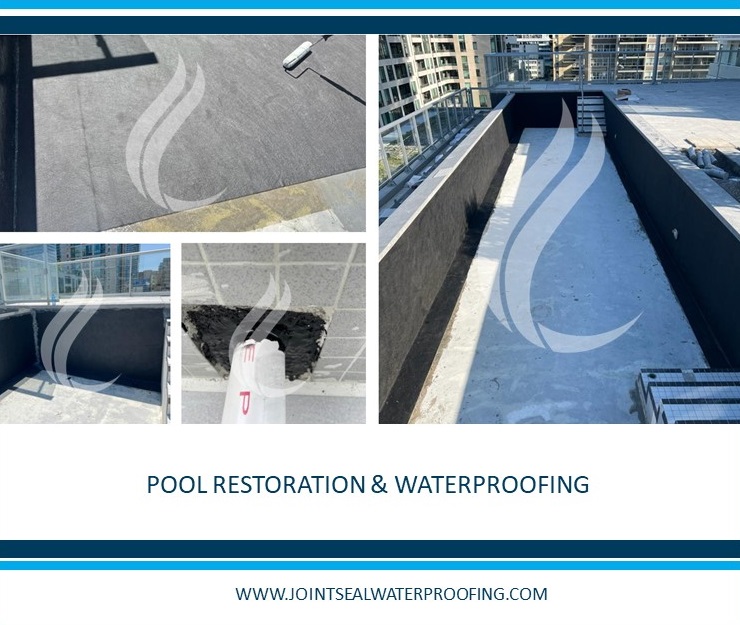
We were contacted to provide a lasting waterproofing solution for an exterior infinity swimming pool located on the sixth floor of a residential building on Erskine Avenue in Toronto. To ensure durable results, a comprehensive repair was proposed: wall crack repair, restoration of the infinity pool edge, waterproofing around the drainpipes, and membrane installation both on walls and floor.
Repair Method
Wall Crack Repair
Over time, even the sturdiest surfaces develop cracks, as concrete ages, making crack repair a must. To prepare the pool for membrane installation, all the wall cracks were filled first. The repair process consisted of the following: each crack was opened up to remove any loose material – to ensure optimal adhesion – and coated with an industrial-strength adhesive before being filled with a specialised crack filler.
Waterproofing around Drainpipes
Proper waterproofing around drainpipes is essential to prevent water infiltration and potential damage to the surrounding structures. To achieve a robust seal and mitigate any risks, a comprehensive waterproofing method was employed. The surface surrounding each pipe was prepared by doing grinding and chipping to create a clean and stable substrate. A cold-applied polyurea-based membrane was applied next – both on the area surrounding the pipe and partially on the pipe itself, for best results.
Restoration of the Infinity Wall Edge
Before the entire pool surface could be coated with a waterproofing membrane, we had to ensure that the infinity pool edge was properly prepared. To restore it and ensure membrane adhesion, some thin patching was done, and the surface was ground off slightly.
Floor and Wall Membrane Installation
A waterproofing membrane that covers the entire pool surface – walls and floor – is vital in preventing water leakage into the structures below, as it will help avoid concrete surface cracks because the substrate will not be exposed to the weather elements.
In this case, geotextile was used for more durable results, together with three coatings of a polyurea-based waterproofing membrane, the top coat being aliphatic (UV-protection), since the pool is exposed to sunlight.
Learn more about our variety of concrete repair and waterproofing solutions by visiting the different pages of our website.
Related: swimming pool repair and waterproofing · concrete crack repair · polyurea membranes · mechanical and utility room floors · documented projects · common questions
Common questions
Frequently asked questions
Does a condo pool have to be drained to repair it?
It depends on where the damage is. A crack that passes through the slab requires a completely empty pool, because the crack cannot be opened against water pressure. A localised repair on a wall needs only a partial drain, down to just below the damage. A floor patch needs a full drain but the refill starts about fifteen minutes later.
How long does it take to drain a condominium pool?
Draining a condominium pool takes a minimum of twenty-four hours, and slower is better. It is not a pump-capacity limit. A full pool holds its shell expanded under load, so emptying it lets the structure contract, and both the drain and the fill are deliberately slowed to keep that movement small.
How long is a condo pool out of service for repairs?
Crack repair takes about two days and the pool refills the next day, so roughly four days end to end once the drain-down is counted. Resurfacing takes ten days to two weeks because the finish has to come off before the hidden damage can be found. A full refurbishment runs about three weeks.
How much hollow concrete is normal in an ageing pool?
About two square feet across the entire shell is normal on a typical ageing condominium pool, and those areas get chipped out and refilled as routine repair. Widespread delamination is a different finding: on one pool, thirty to forty percent of the surface was hollow because the concrete was never properly vibrated when it was placed.
How are pool cracks estimated before the pool is opened up?
On a suspended condominium pool, count the cracks visible from the mechanical room underneath and multiply by two. Any crack showing on the underside is certainly on the pool side as well, and there will be a few more up top because not every crack passes right through. Where cracking is present, the working allowance is around twenty percent of the surface area.
Why is a pool perimeter joint water-tested before the paving goes back?
The perimeter expansion joint is flood-tested the moment it is rebuilt, before any paving is relaid, because a defect found afterwards means lifting the paving again — which is most of the labour in the job. Testing an open joint costs an hour. It is the only formal quality hold point in a pool repair.
Related services & repair types