Project & Insights
Regional Airport Concrete Repairs | Joint Seal
September 2, 2020
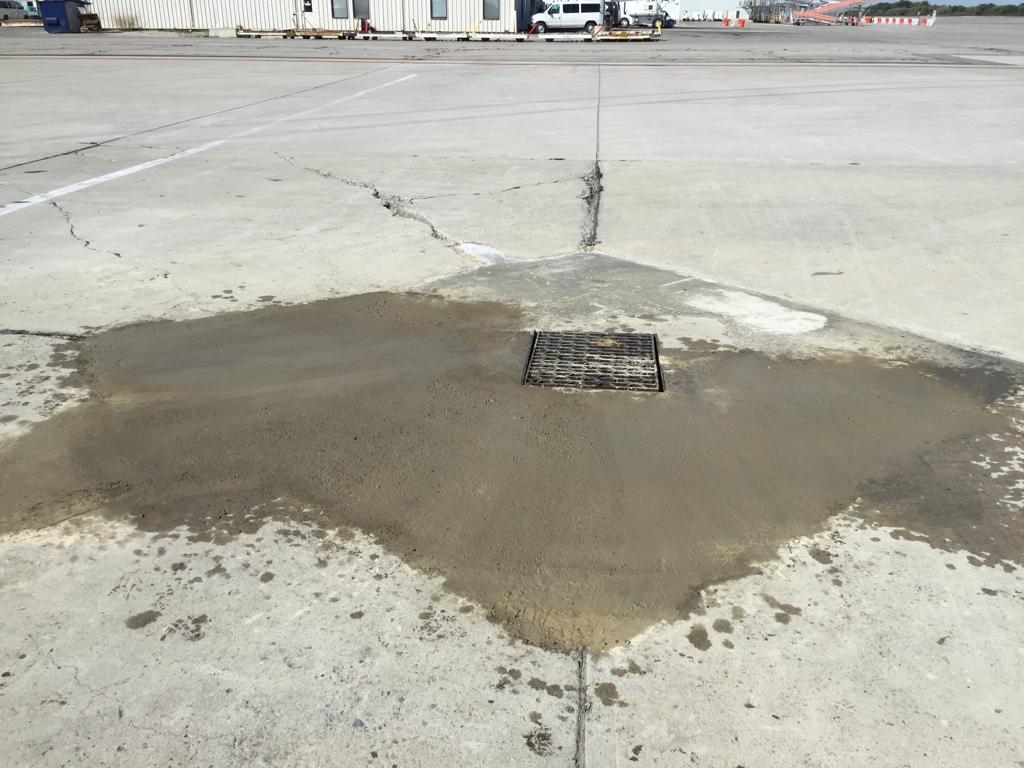
Concrete repairs on airside runways at a regional Airport turned into a multi-phase project.
Phase 1 - 2017
An extensive inspection was done, covering thousands of square feet, to measure and plot every crack and catch basin. The resulting scope of work included concrete crack repair, patching, and storm drain repairs.
Issues
Lose Concrete
Lose concrete around cracks and potholes can cause damage to airplane engines: if even a small piece were to get into one, it would involve an extremely expensive repair (up to 2 million dollars per engine!).
Crack repair and patching had to be done to prevent such costly potential damage from occurring.
Unlevel Storm Drain Slab
Since the storm drain pads became raised by close to two inches, due to freeze-thaw cycles that affect the two slabs of concrete involved, water could no longer drain properly and began ponding on the airside. When the water accumulated and froze, it caused further concrete damage.
Solutions
Crack Repair
A three-step repair process was followed, including crack routing with a saw, treatment with a specialized adhesive to insure immediate and durable repair, followed by cement filling.
Patching
Under traditional repair methods, patching requires a minimum of two-inch demolition in the affected area. The use of our unique products, Polyforce Plus Adhesive, and Polyforce Polymer Cement, permits thin patch applications, without use of any forming or concrete injection, making the job much more cost-efficient and faster. The combination of Polyforce Plus Adhesive and Polymer Cement creates a monolithic patch which is able to restore structural integrity of the repaired slab.
Patching also involves three steps: removal of delaminated and unsound concrete, application of adhesive, and patch installation.
Storm Drain Repair
Storm drain pad had to be regraded towards the catch basin to ensure proper drainage. This was possible thanks to our thin patch applications (as thin as one inch, in this case), and made it unnecessary to rebuild the entire catch basin. Since the resulting repair was highly successful, we were invited to go back during the following years to repair all of the catch basins.
Phase 2 – 2018-2019
The remaining five catch basins were repaired. Further crack repair (cracks as long as 30 feet) and patching were done, to rehabilitate airside runway concrete surfaces.
Phase 3 – 2020-2021
The last phase of concrete repairs has been delayed due to COVID-19.
Work at the Airport
Because of the level of satisfaction with our work, we were recommended to one of the tenants of the Greater Toronto Airport Authority (GTAA) and invited to bid on a project to be carried out there. Read our next blog to find out about the repairs done there.
Related: expansion joint repair and injection · traffic surface repair · concrete repair and restoration · overhead expansion joint injection · documented projects · common questions
Common questions
Frequently asked questions
What is the difference between a top-slab and a mid-slab expansion joint?
A top-slab joint sits at the ceiling of P1, under the deck that carries landscaping or asphalt at grade. A mid-slab joint sits between parking levels — the floor of P1 and the ceiling of P2 — with nothing buried above it. The difference determines how the joint can be accessed and repaired.
How long does a garage expansion joint repair take?
A negative-side injection on a 20-foot joint span typically runs about two days: injection and forming on day one, form removal and cosmetic finishing on day two. A top-side excavation repair on the same joint is usually a five- to six-month project with the area fully closed.
What temperature is too cold for concrete repair in Toronto?
Concrete repair needs air temperature above plus five degrees Celsius, because below that ice crystals form in the substrate and no repair material will bond to them. Plus ten degrees is where most materials genuinely perform. Between five and ten, the morning-to-evening temperature swing creates enough dew that the work needs materials tolerant of a damp surface.
Is a delaminated patch a structural problem or a cosmetic one?
A single delaminated patch in a parking garage slab is usually not structural on its own, but the open seam lets salt water reach the reinforcing steel, and corroding rebar is structural. The patch is the symptom. What matters is how long the water has had a path in, which is why deferred patching gets more expensive rather than staying the same price.
What is a sounding test on concrete?
A sounding test is tapping concrete with a specialised hammer or a metal rod and listening to the response. Solid concrete rings; delaminated concrete sounds hollow. It is the test that decides whether a crack gets injected or the surrounding area gets removed and patched, and it finds damage that looks completely sound to the eye.
How long before a thin patch can be walked on or driven on?
Polymer cement patches with Polyforce Plus adhesive cure in roughly four hours, comparable to how long conventional concrete takes to set, so most repairs take foot traffic the same day. Temperature affects it, and whatever coating goes over the patch usually governs the return-to-service date rather than the patch itself.
Related services & repair types