Project & Insights
Airport Terminal Expansion Joint Repair | Joint Seal
December 18, 2024
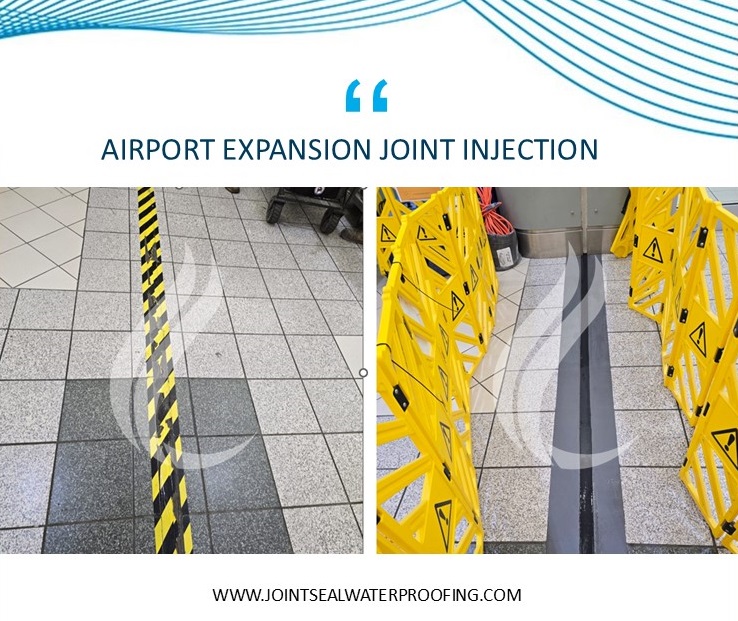
When it comes to airport infrastructure, safety and functionality are paramount. At the Airport’s Terminal 3 Departures, a critical repair was undertaken to address a worn-out expansion joint in the busy terminal area. Expansion joints play an essential role in maintaining structural integrity and user safety in high-traffic environments like airport terminals. This project focused on the Toronto Relay Expansion Joint, ensuring that the area would be safe and operational for years to come.
The Repair Method
The repair work involved the removal and replacement of the damaged expansion joint membrane and adjacent sections. To start, the existing membrane was carefully removed, along with the existing half-tiles on each side of the joint. A continuous installation of a polyurethane resin floor screed was applied to reconstruct the edges of the joint, ensuring proper alignment and seamless integration with the surrounding surface. This approach eliminated the need for new half-tiles and provided a uniform, durable finish.
The expansion joint was cleaned out and filled with a specialised elastomeric material designed to produce dimensionally stable, high impact and flexible coatings – ideal for expansion joint injection applications, as they enhance structural integrity and create a smooth, professional finish that eliminates uneven surfaces, ensuring pedestrian safety. This meticulous approach ensured the repair met the high standards required in such a demanding environment.
Why Expansion Joint Repairs Are Essential
Expansion joints are a crucial component of any large structure, particularly in areas like airport terminals where temperature changes, heavy foot traffic, and structural movements are constant challenges. Over time, wear and tear on these joints can result in uneven surfaces, creating tripping hazards for passengers and staff alike. For a busy terminal like the Airport’s Terminal 3, ensuring the safety of its millions of annual travelers is non-negotiable.
In conclusion, the successful repair of the expansion joint at Terminal 3 Departures highlights the importance of proactive maintenance in high-traffic spaces. Through precision work and quality materials, this project ensures the safety and functionality of one of Canada’s busiest travel hubs.
Learn more about a great variety of concrete repair and waterproofing solutions we offer by vising the different pages of our website: https://www.jointsealwaterproofing.com
Related: expansion joint repair and injection · traffic surface repair · parking garage repair · overhead expansion joint injection · documented projects · common questions
Common questions
Frequently asked questions
What is the difference between a top-slab and a mid-slab expansion joint?
A top-slab joint sits at the ceiling of P1, under the deck that carries landscaping or asphalt at grade. A mid-slab joint sits between parking levels — the floor of P1 and the ceiling of P2 — with nothing buried above it. The difference determines how the joint can be accessed and repaired.
Why is a mid-slab expansion joint repair cheaper?
Because both faces of the joint are exposed, nothing has to be excavated to reach it. Material can be gravity-fed from the top instead of pressure-injected from below, and mechanical joint systems can be installed directly. Access is not the constraint, so the method is chosen on movement and traffic rather than reachability.
How long does a garage expansion joint repair take?
A negative-side injection on a 20-foot joint span typically runs about two days: injection and forming on day one, form removal and cosmetic finishing on day two. A top-side excavation repair on the same joint is usually a five- to six-month project with the area fully closed.
How much does it cost to repair one parking garage expansion joint?
A single 20-foot expansion joint span repaired by negative-side injection runs in the range of six to ten thousand dollars in the GTA. Much larger figures quoted for garage joint work usually cover many joints across a large section of the structure, so it is worth asking how many spans a proposal actually includes before comparing two numbers.
Can a leaking expansion joint cause structural damage in a parking garage?
Yes, over time. Garage slabs bear on ledge beams, and expansion joints frequently run directly above them, so water exiting the joint saturates the top of the beam. Flowing water deteriorates concrete and opens voids that carry more water, and a ledge beam carries the slabs above it.
Is it cheaper to fix the joint or wait and repair the concrete later?
Fixing the joint is far cheaper. A negative-side injection on a 20-foot joint span is about a two-day job. Repairing a saturated, spalling structural beam is a larger scope on a separate budget line and usually involves an engineer, because at that stage it is structural work rather than waterproofing.
Related services & repair types