Project & Insights
Do I Need an Engineer to Repair an Expansion Joint in Ontario?
August 22, 2026
By Valeriy, Application Specialist, JSW Waterproofing
The question behind the question is usually whether the board is exposed if it hires a waterproofing contractor directly. Here is the honest shape of it.
Waterproofing an expansion joint does not require an engineering stamp, because sealing a joint is not a structural repair and does not determine whether the structure stands. An independent engineer is still worth having on larger work, and boards commonly bring one in above roughly fifty thousand dollars. On a single 20-foot span at six to ten thousand dollars, the fee is often hard to justify against the repair itself.
So the real question is not whether you need one. It is what you want one for.
What is an engineer actually being hired to do?
An engineer on a garage joint programme does three things worth paying for, and none of them is signing a form.
The first is reviewing the diagnosis before a method is chosen. A drip in the ceiling of P1 does not say where the membrane failed, and choosing between injection and excavation on the strength of the drip alone is guesswork.
The second is holding the contractor to the specified sequence while the work happens. The third is inspecting the finished installation. That last one is the item most boards under-buy and most regret skipping.
What does that inspection look like in practice?
On a mid-rise residential building on Northern Heights Dr in Richmond Hill, expansion joints on the parking deck needed waterproofing after a different contractor had installed the joint profiles. We welded the joint corners, and the welding was inspected and approved by engineers before anything went over it. Then the rubber membrane went into the joints with crowbars so the profiles were not damaged, the substrate was cleaned and primed with a bonding agent, and the parking-series elastomeric concrete was installed. Three mechanical joint profile series were involved across the deck — multi-cell, ribbed and two-cell.
That is what a hold point is for. The welds were the thing that could not be inspected later, so they were inspected before they were covered. The record is in the elastomeric concrete joint system project.
When is the engineering fee hard to justify?
On one span. A 20-foot joint injected from inside the garage is about a two-day job in the range of six to ten thousand dollars, and a full engineering scope on top of that can approach the cost of the repair.
Our opinion: on a single joint, spend the money on the repair and ask for photographs of each stage instead. On a multi-span programme, hire your own engineer and give them a real mandate — attend the first span, inspect it, and write down what good looks like so the remaining spans are measured against it. Half-hiring an engineer to review a proposal on paper is the version that adds cost without adding certainty.
What do engineers ask us first?
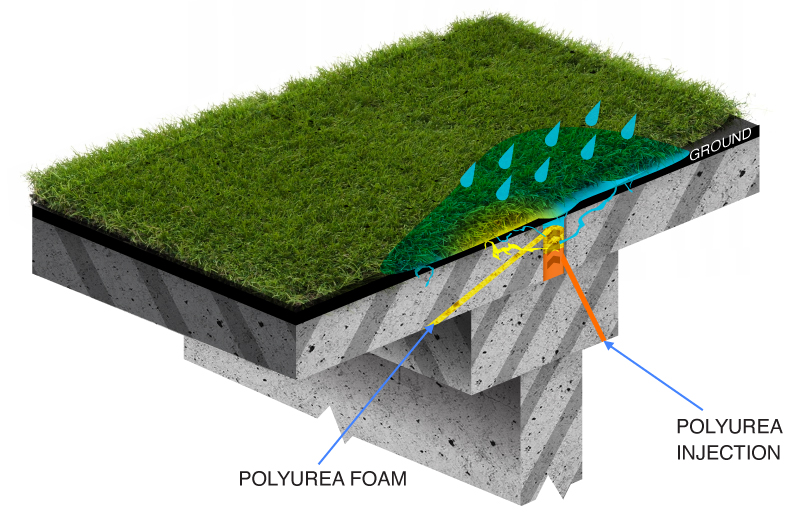
Whether the injection pressure will lift the deck membrane above. It is the single most common technical question we get from consulting engineers, and the answer is no — the pressure is enough to displace water out of the joint and travel back up the path the water was using, not to lift a membrane.
The other recurring one is effectiveness. No method is 100 percent effective, and a consulting engineer on one GTA condo board acknowledged that about his own top-side recommendation, because nobody knows every place the membrane and joint have cracked before digging. That same engineer conceded the injection approach after seeing it work on the building.
When does the work stop being waterproofing?
When the concrete has deteriorated. Garage slabs bear on ledge beams, expansion joints frequently run above them, and a joint that has dripped onto a beam for years leaves saturated concrete, efflorescence, sometimes rust staining and spalling.
Repairing that beam is structural work on a separate budget line, and it usually does involve an engineer. The line worth not crossing is exactly there, which is why we argue for sealing joints while they are still a water problem. The mechanism is set out in the ledge beam problem.
What should you ask before you appoint anyone?
Ask the engineer what they will inspect and when. Ask the contractor what they will photograph. Then check that the two lists overlap on the steps that get covered up.
Book an inspection and we will tell you what we would want a third-party engineer to look at on your particular joints, and what we would not spend the fee on.
Book a JSW inspection · More on parking garage repair, expansion joint repair and concrete surface repair. Our FAQ answers the process questions boards raise before tendering.
Common questions
Frequently asked questions
Does waterproofing a garage expansion joint need an engineer's stamp?
Waterproofing does not require an engineering stamp, because sealing a joint is not a structural repair and does not determine whether the structure stands. An independent engineer is still worth having on larger projects to validate the installation, and boards commonly involve one above roughly fifty thousand dollars.
What does a consulting engineer actually do on a joint repair?
Three useful things: review the diagnosis before a method is chosen, hold the contractor to the specified sequence during installation, and inspect the finished work. On one Richmond Hill garage the engineers inspected and approved the welded joint corners before the elastomeric concrete went in, which is exactly the kind of hold point worth paying for.
At what project size do boards usually bring in an engineer?
Boards commonly involve an independent engineer above roughly fifty thousand dollars of work. On a single 20-foot joint span in the range of six to ten thousand dollars, the engineering fee is often hard to justify against the repair itself, though engineers who do a lot of this work will sometimes price accordingly when they know the installation method.
Is any expansion joint repair method 100 percent effective?
No method is 100 percent effective, including full excavation. A consulting engineer on one GTA condo board acknowledged this about his own top-side recommendation, because the exact locations of every membrane and joint crack are unknown before digging. Injection has the advantage of being repeatable at low cost if a joint needs a second pass.
Should the engineer who designed the repair also inspect it?
An independent third-party engineer is the more useful arrangement, because the point of the review is to confirm what was installed rather than to confirm the specification. We work with third-party engineers on that basis and have no objection to a board appointing its own.
When does a joint leak stop being a waterproofing question?
When the concrete underneath has deteriorated. Repairing a saturated, spalling structural beam is a larger scope on a separate budget line and usually involves an engineer, because at that stage it is structural work rather than waterproofing. Sealing the joint while it is still only a water problem keeps it out of that category.
Related services & repair types