Project & Insights
Our concrete stairs are cracking and spalling — repair or replace?
August 18, 2026
By Boris Gopka, Owner, JSW Waterproofing — 2.5 million square feet of concrete patching across the GTA
A precast concrete staircase with cracked and spalling steps can almost always be repaired rather than recast, at roughly a quarter of the cost, with the stairwell back in service in about two days instead of two weeks. The repaired stairs last five to ten years and often longer.
Most property managers never hear this option. The only route they have been offered is demolition and recasting, so damaged stairs get deferred instead of fixed.
Why is the nosing always the part that fails?
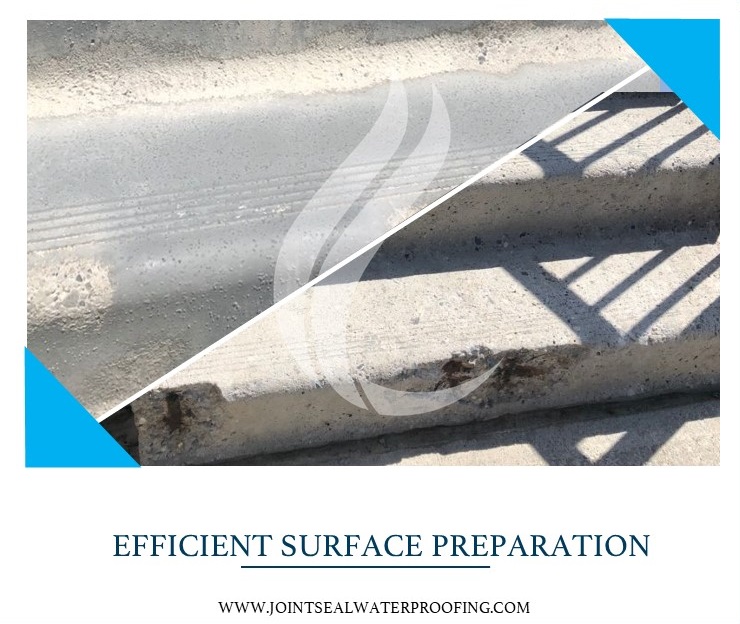
The bullnose — the rounded front edge of each step — takes more wear than any other part of a staircase, so cracking and spalling appear there first. Every footfall lands on it, water drains over it, and the road salt tracked in through a Toronto winter goes with the water.
That creates a repair problem with a specific shape. At the nose you might need two inches of material to rebuild the profile. Behind the nose, across the tread, the same patch tapers to less than a quarter inch. In cross-section the repair is a wedge.
That wedge is why stairs are close to impossible to repair by conventional means. Most patch material has no strength under two inches, so a contractor working that way cannot feather the back of the repair — and cannot leave a two-inch slab standing proud of the tread either. The minimum thickness the patch material needs is what rules the method in or out.
How do you rebuild a step without forming it?
A nosing is rebuilt by sculpting polymer cement over a Polyforce Plus adhesive and trowelling it smooth, with no formwork involved. The mixture handles like plasticine. You shape the geometry of the step by hand, get the profile right, then trowel to an even surface.
Not needing formwork is most of the labour saving. Forming a run of steps to recast nosings is slow, fiddly work, and the forms have to come off before anyone can see whether the geometry is right.
The sequence on a typical set:
- Remove all loose and delaminated material and clean the substrate back to sound concrete
- Treat exposed rebar where any is showing
- Apply the adhesive, which cures in wet and moist conditions
- Sculpt polymer cement to rebuild the nosing and tread geometry, feathering to under a quarter inch
- Coat the whole staircase, not only the repairs
- Finish with a non-slip surface
Why coat the whole staircase and not just the repairs?
The coating covers the entire staircase because it is what keeps water out of the concrete and delivers the non-slip walking surface, and a coating that stops at the edge of each repair leaves every seam exposed.
Two routes are normal. Fibreglass sheet set on adhesive, where the stairs need genuine reinforcement. Or a UV-resistant coating on its own, which is the more budget-conscious option and is non-slip in itself.
On a stairwell, non-slip isn’t a finish preference. It’s a good part of why the repair is worth doing.
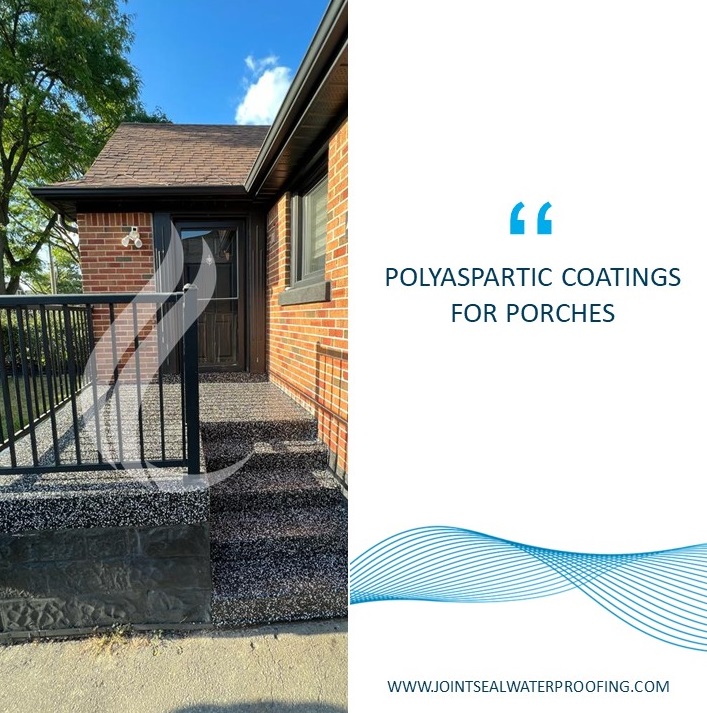
On three sets of stairs and porches at a triplex on Nelson Street in Oakville we used anticorrosive rebar paint, a specialised concrete mix, crack filler and a two-layer polyaspartic membrane with an anti-slip aggregate — polyaspartic being a material designed to hold up for at least a decade.
What does repair cost against replacement?
Recasting a medium staircase, call it a six to eight foot rise, runs in the region of seventeen thousand dollars. Repairing and coating the same staircase typically lands between three and six thousand, depending on how much geometry has to be rebuilt.
Those are ranges rather than quotes, and the drivers are straightforward:
- How many steps, and how much of each nosing is gone
- Whether rebar is exposed and corroding
- Whether the staircase gets fibreglass reinforcement or a coating alone
- Access, and whether the work can be staged around residents
What we don’t see is pushback on the number. There is nothing cheaper or faster available, and a staircase with broken nosings is a tripping hazard and a safety violation, so it isn’t really discretionary spending.
How long is the stairwell out of service?
Repairing a staircase takes roughly one day of preparation and one day of application, and it reopens almost immediately because the materials cure fast. Recasting takes one to two weeks with the staircase shut the whole time.
For most buildings that difference matters more than the money. A stairwell is emergency egress. Closing one for two weeks is a life-safety and code problem before it is an inconvenience.
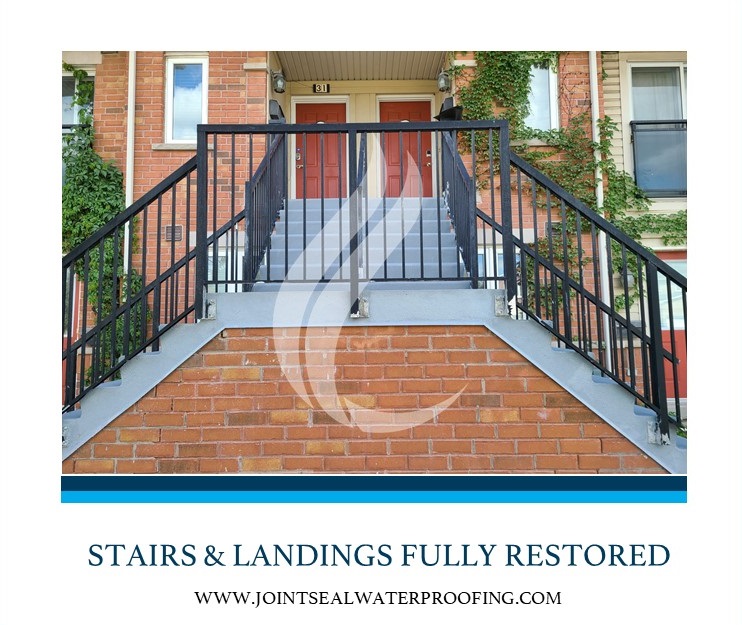
On a wide staircase there’s a further option: repair the left half, then switch to the right, and the stairs stay usable throughout. We staged the same way across 23 townhomes in four buildings on Guildwood Way in Mississauga, working building by building, with patches as thin as 5 mm where traditional methods would have needed at least two inches of demolition.
How long does a repaired staircase last?
A properly repaired and coated concrete staircase lasts five to ten years before it needs attention again, and often longer. We have stairs done close to ten years ago that were in poor shape when we started and are in the condition we left them.
That’s the comparison worth putting to a board. Not repair against replacement on price alone, but a repair cycle measured in years against a recasting cycle measured in decades — with the recasting costing four to five times as much up front and taking the stairwell out of service to get there.
What to do next
Go and look at the nosings. Crumbling front edges, exposed rebar, or a step that has lost its profile mean the staircase is a candidate for repair, and the earlier that happens the less geometry has to be rebuilt. Once rebar is corroding, the scope grows.
A walk-through with a marked-up count of affected steps gives you a number to take to the board. That’s how we scope concrete stair repair across Toronto and the GTA.
Common questions
Frequently asked questions
Can precast concrete stairs be repaired, or do they have to be replaced?
Precast concrete stairs with cracked or spalling nosings can be repaired in place in the large majority of cases. Replacement is rarely necessary unless the structural slab of the staircase itself has failed. The repair rebuilds the step geometry with sculpted polymer cement and then coats the staircase; replacement means demolition and recasting at roughly four to five times the cost.
How long does a concrete stair repair take?
A typical concrete stair repair takes about two days — one day of preparation and one of application — and the stairs can be used almost immediately afterwards, because the materials cure in hours rather than days. Recasting the same staircase takes one to two weeks with the stairwell closed throughout.
Do the stairs have to be closed while they are repaired?
A staircase wide enough to work on in halves does not have to close: the left side is repaired while residents use the right, then the sides switch. On a narrow staircase the closure is measured in days rather than weeks. This matters because a stairwell is emergency egress and cannot simply be taken out of service.
Is spalling on exterior concrete steps a safety issue?
Spalling on the nosing of a concrete step is a tripping hazard and a safety violation, because the walking edge is exactly where people put their weight. It is also where water and road salt reach the reinforcing steel. Deferring the repair means the rebar corrodes and the scope grows from a surface repair into a structural one.
What makes a repaired staircase non-slip?
The non-slip surface comes from the top coat — either a UV-resistant coating that is non-slip in itself, or a membrane with an anti-slip aggregate broadcast into it. On exterior stairs this is not optional. A smooth coated step in a Toronto winter is worse than the damaged concrete it replaced.
Related services & repair types