Project & Insights
What should a compactor room floor repair cost?
September 10, 2026
By Valeriy, Application Specialist, JSW Waterproofing
A compactor room floor in a Toronto condominium or co-op gets finished one of three ways, and on a room around 12 by 30 feet the spread runs from roughly $5,000 to roughly $30,000. The middle option — a liquid-applied membrane over primer and base coat, with aggregate broadcast into it for grip — is what most buildings should buy. The cheapest option starts breaking up inside two years, and the most expensive one buys durability the room will never live long enough to use.
What are the three ways to finish a compactor room floor?
A compactor room floor is finished with either a thin epoxy or polyaspartic coating, a liquid-applied urethane membrane system, or an industrial PUMA resin floor. All three sit on top of the same concrete repair work underneath. What separates them is the resin, and the resin is what sets both the price and how the floor behaves under bins.
| Option | Rough cost, 12 × 30 room | How it goes down | Where it fails |
|---|---|---|---|
| Epoxy or polyaspartic coating | ~$5,000 | Rolled, thin film | Cracks under dragged bins, then lets water through |
| Liquid-applied membrane with broadcast | ~$10,000 | Primer, base coat, topcoat, rolled | Wears with the room, on a normal cycle |
| Industrial PUMA resin | ~$25,000–$30,000 | Multiple components, squeegee-applied | Outlives the room it is in |
Those are ranges for a room of that size with a normal amount of concrete repair in it, not quotes. What actually moves the number is how many square feet of slab have to be rebuilt and whether the drains are being replaced. Both of those sit under every one of the three floor coating options.
Why does an epoxy or polyaspartic coating fail in a compactor room?
A thin epoxy or polyaspartic coating fails in a compactor room because the bins dragged across it crack the film almost immediately. Bin movement is not an occasional event in that room — it is the daily operation. Once the film cracks it opens, wash-down water gets underneath it, and the concrete you just repaired starts deteriorating again with a coating sitting over the top hiding it.
The visible complaint arrives first. Epoxy is glossy, so every scratch and every scuff shows, and the floor discolours. A building spends around $5,000, and two months later the floor is marked up. The manager looks at it and reasonably concludes the contractor did a poor job, when the material is simply doing what that material does in that room.
We have not put one down in a compactor room recently, and that is a deliberate position rather than an oversight. Polyaspartic is a genuinely good product in the right place — where a polyaspartic coating does make sense is a stairwell or a mechanical room where nothing heavy is being dragged across the floor every morning.
What does the mid-range build-up actually involve?
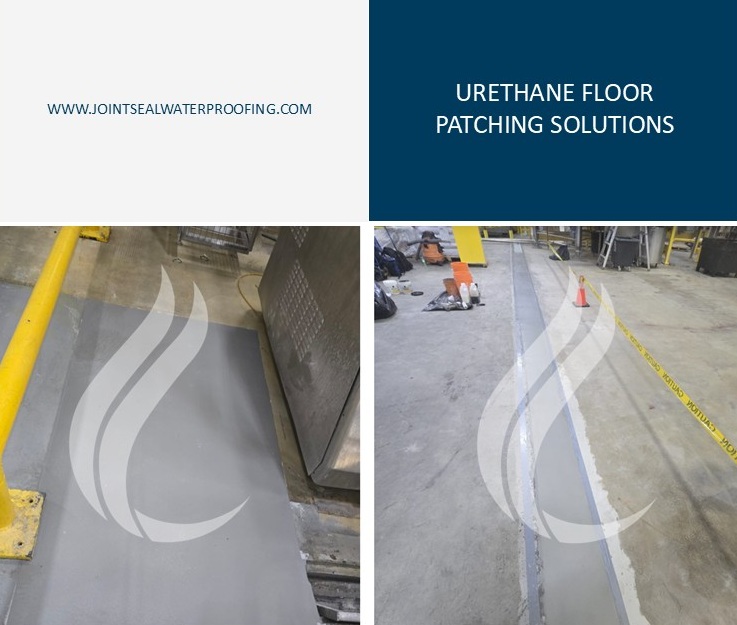
The mid-range compactor room build-up is concrete repair and re-sloping first, then primer, a base coat, and a topcoat with aggregate broadcast into it for slip resistance. On a residential co-op on Weldrick Rd E in Richmond Hill we rebuilt a 12 by 30 compactor room this way in the fall of 2025, and the scope is a fair picture of what these rooms need.
The entrance took 8 square feet of concrete restoration on its own, because it is the only way bins get in and out and it absorbs every pickup. Another 3 square feet needed repair elsewhere. Two floor drains were not collecting the superintendent’s wash-down water, so 16 square feet of floor was re-sloped and both drains replaced bolt-for-bolt. An 8 square foot area was purged — all loose concrete stripped out to a sound base before new material went in — and a fine crack 3 linear feet long was repaired. Then the whole 12 by 30 was ground off and coated, with the membrane carried a foot up the walls.
Four working days, October 14 to 17. Day one the cracks were opened, cleaned and rebuilt with new concrete over a Polyforce adhesive bond coat. Day two, crack filler across the minor surface cracks. Day three, primer and base coat, left to cure. Day four, the Sikalastic topcoat with the broadcast. The crew came back on November 11 for one thing only: the drain grate.
When is an industrial PUMA system worth three times the price?
An industrial PUMA floor — polyurethane methacrylate resin — is worth its price only where a room takes abuse well beyond ordinary bin traffic. It is a heavier, multi-component build, squeegee-applied rather than rolled, with a longer cure between components. On a room this size it runs about a day longer than the membrane build, which is our estimate rather than a measured figure.
It also smells. PUMA resins give off a strong odour during installation and the room needs forced ventilation to clear it, which matters when the compactor room sits inside an occupied building. In our experience that is not what stops people buying it. Residents complain and then live with it for three or four days. The price is what stops them: $25,000 to $30,000 against $10,000 for the same room.
Why does the longest-lasting floor not always make sense?
The longest-lasting compactor room floor is frequently the wrong purchase, because the room reaches the end of its practical life before the coating does. Say the premium system lasts twice as long as the mid-range one — illustrative numbers, not a service-life claim we can stand behind for a specific product. The extra life still does not pay, because a compactor room accumulates dirt, staining and general abuse to the point where the building wants it redone anyway, well before the resin gives out.
Buying a floor that outlasts the room is money spent on a benefit nobody collects. Matching the material to how long the room will actually be left alone is both cheaper and more defensible in front of a board. That is the opposite of what most contractors will tell a property manager, and we think most contractors are wrong about it.
How does a building handle its garbage while the room is closed?
A building normally closes the chute and keeps bins outside with the lids on while its compactor room floor is being rebuilt. For a four-day job that is the cleanest arrangement, and it is what most superintendents and managers choose once the sequence is explained to them.
The alternative is working half the room while the other half stays in service. We will do it, but we argue against it. Grinding happens twice instead of once, mobilisation happens twice, curing time runs on both halves, and a joint gets built down the middle of a membrane whose entire purpose is to be continuous. In the wettest, most abused room in the building, a deliberate seam through the waterproofing is a strange thing to design in. The same logic drives how we sequence garbage and compactor room restoration generally, and how we phase work in other utility rooms that cannot close for long.
Before you price anything, walk the room after the superintendent’s next wash-down and look at where the water sits ten minutes later. If it is standing anywhere other than the drains, the floor needs re-sloping and no coating quote is complete without it. Photograph the entrance and the drain surrounds, get the square footage of the room, and send those to us — that is enough for a scoped assessment you can take to the board, and more of these questions are answered in our waterproofing FAQ.
Common questions
Frequently asked questions
Is a compactor room floor a maintenance item or a reserve fund project?
A full compactor room floor rebuild is a reserve fund item in most Ontario condominiums, because it replaces a building component on a predictable cycle rather than fixing a fault. Patching a few square feet of spalled concrete is maintenance. The dividing line is usually whether the drains and the membrane are being renewed as a system or a defect is being closed out.
How can a property manager tell the coating was installed properly?
Pour a bucket of water at the far corner and watch where it goes. On a correctly rebuilt compactor room floor it runs to the drain and leaves nothing standing. Then look at the wall junction: the membrane should carry up the wall as one continuous piece, not stop at a caulked line where the floor meets the block.
Can a compactor room floor repair wait until next year?
Deferring is reasonable while the slab is sound and the only complaint is appearance. It stops being reasonable once water is standing after every wash-down, because saturated concrete under a failed membrane keeps deteriorating and the repair area grows. A three square foot patch left two winters becomes a much larger concrete rebuild.
Why do two compactor room quotes differ so much?
Usually because they are not quoting the same floor. One price covers a coating over the existing slab; the other includes concrete repair, re-sloping to the drains and new drain bodies underneath it. Ask each contractor how many square feet of concrete repair and re-sloping are in the number, and the quotes become comparable.
What does standing water in a compactor room mean?
Standing water after wash-down means the floor no longer falls toward the drains, and it is the earliest signal that a rebuild is coming. The slab rarely moves on its own. More often the drains sit slightly high after years of patching, or the original fall was lost when the floor was last resurfaced without re-establishing it.
Related services & repair types