Project & Insights
Cold Joint Repair & Waterproofing Toronto | Joint Seal
February 5, 2025
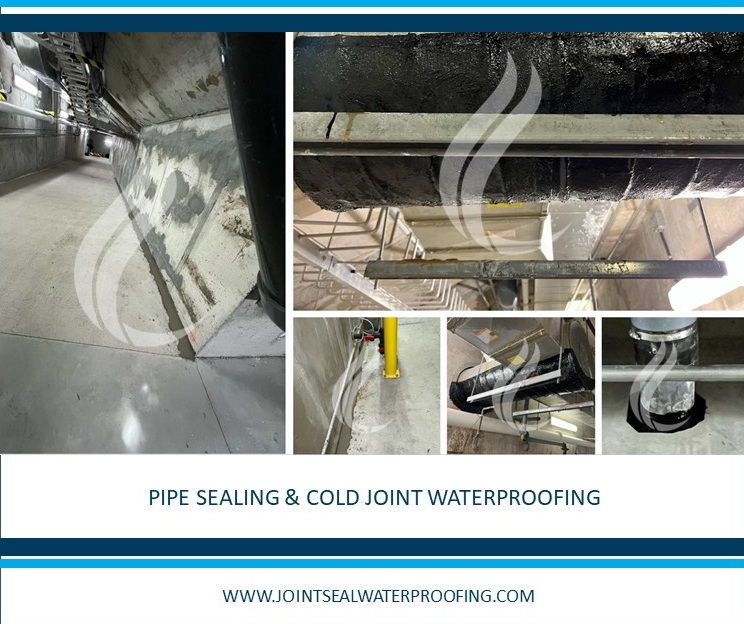
A cold joint is the seam where fresh concrete was poured against concrete — or another material — that had already set, so the two never fully bonded. It is a plane of weakness built into the structure on the day it was made, and it is where water gets in long before any crack appears.
A cold joint cannot be sealed from the surface. It has to be opened, reinforced across, and membraned.
Why cold joints leak
There is no continuous bond across the seam, only two faces touching. Moisture, temperature swings and external pressure work the gap wider every year. The most common places we find them leaking are the wall-to-floor seam in a mechanical room, the joint where a brick wall meets an asphalt or concrete floor at grade, and the seam between pours in a garage wall.
Surface caulking over one of these lasts a season or two. It is sitting on the moving face of the joint with nothing anchoring it into sound material on either side.
The repair method
- Strip back to the joint. Flashing, membrane, finishes — whatever covers the seam comes off. On one job that meant removing the flashing and then a two-foot rubber membrane beneath a window before the joint was even visible.
- Open and clean the joint. The seam is cut open and cleaned out so what goes in bonds to sound material, not to dust and debris.
- Inject, where it is running. Under active head, hydrophobic polyurethane injection resin (Joint Seal Flex) is injected to stop water movement before anything is built over it.
- Bond it. A monolithic, industrial-grade epoxy adhesive is applied across the opened joint to create a continuous bond where there was none.
- Reinforce across it. Geotextile fabric is installed over the joint. This is the step that gives the repair flexibility — it lets the finished assembly move with the joint instead of tearing along it.
- Membrane it. A polyurea-based sealing polymer is applied over the reinforcement to form the watertight layer.
- Reinstate. Flashing and finishes go back.
Where the joint is in a floor slab and a coating follows, the joint is coved at a 45-degree angle rather than left as a square internal corner, so the membrane is never asked to turn a sharp edge.
A real example
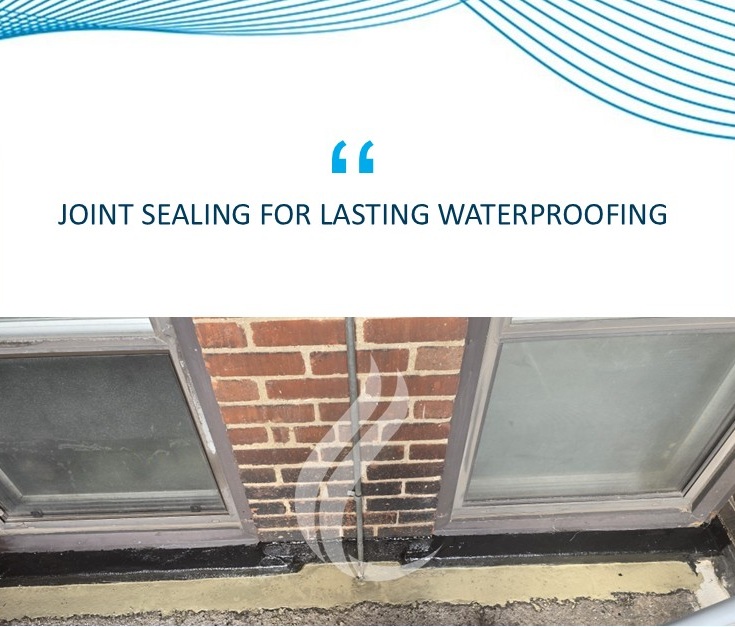
A low-rise residential building on Bloor St. W in Toronto: a 35-linear-foot cold joint under a window where a brick wall met an asphalt floor, letting water in from the street to the unit behind it. Flashing off, two-foot rubber membrane out, joint opened and cleaned, epoxy adhesive, geotextile, polyurea sealing polymer, flashing reinstated.
Cold joint or expansion joint?
They get confused constantly and they are not the same thing.
An expansion joint is designed into the structure to accommodate movement, and it is repaired by injection with a flexible resin that stays flexible. A cold joint was never designed at all — it is an accident of the pour sequence — and it is repaired by bonding, reinforcing and membraning across it.
If a contractor proposes to inject a cold joint and stop there, they are treating it as an expansion joint. It will re-open.
What this costs to leave
The materials carry a Ministry of Transportation Ontario rating for roughly a 25-year service life — a material service-life rating, not a warranty term. What a leaking cold joint costs is a different number: it is water reaching reinforcing steel, and steel that has been wet for years turns a joint repair into a concrete repair.
The opinion, stated plainly
Almost every cold joint we open has been caulked at least once. Caulk is what you use when you do not want to find out how far the joint runs. Opening it costs more on the day and it is the only version of this repair that is still working in ten years.
Related: cold joint repair · expansion joint injection · polyurea membranes · mechanical and utility room floors · documented projects · common questions
Common questions
Frequently asked questions
Do you need to find where the water is entering before injecting?
No, and that is the main advantage of the method. The resin takes the path of least resistance, which is the same route the water used, so it travels back toward the entry point on its own. On garage decks this matters because water can travel 20 feet or more under a debonded membrane before it exits at the joint.
What kind of resin is used to inject a leaking expansion joint?
A hydrophobic polyurethane injection resin — JSW uses Joint Seal Flex, manufactured in the United States for this application. It does not react with water, is heavier than water, and stays flexible after curing so the joint can keep expanding and contracting through Toronto's freeze-thaw cycles.
Does injection resin react with the water already in the joint?
No. Hydrophobic resins like Joint Seal Flex do not foam or react when injected into a cavity full of moisture, which keeps the behaviour predictable in a wet joint. Because the resin is also heavier than water, it settles beneath standing water and pushes it ahead as more material is pumped in.
How does the crew know when the joint is properly filled?
By watching the injection pressure. If resin is still escaping into the structure, the pressure keeps moving. If the joint is filling and holding, the pressure climbs and stays high. That reading tells the operator whether to keep pumping or stop.
What is the difference between a cold joint and an expansion joint?
An expansion joint is designed into the structure to take movement and is repaired by injecting a resin that stays flexible. A cold joint is not designed at all - it is the seam where a new pour met concrete that had already set - and it is repaired by opening it, bonding across it and membraning over it. Injecting a cold joint and stopping there treats it as something it is not.
Can a cold joint just be caulked?
Not durably. Caulk sits on the moving face of the seam with nothing anchoring it into sound material either side, so it lasts a season or two. Almost every cold joint we open has been caulked at least once already.
Related services & repair types