Project & Insights
Exterior Wall Waterproofing
April 5, 2021
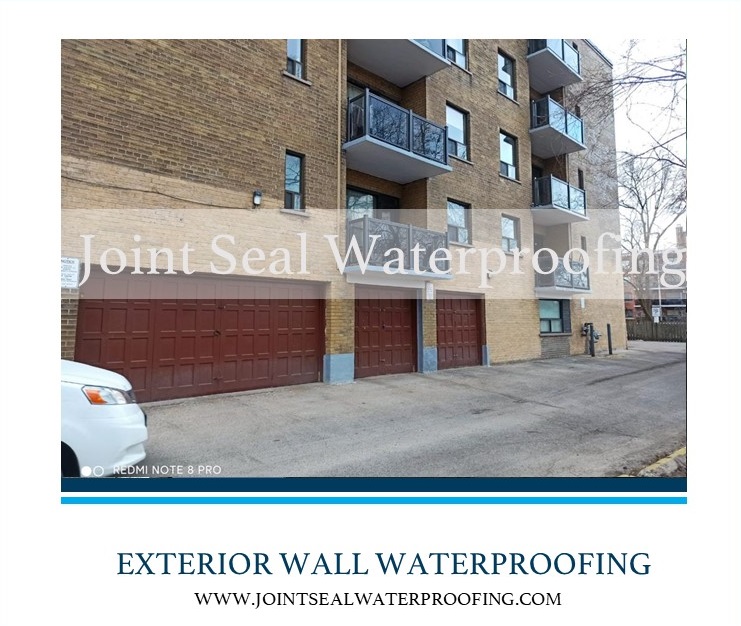
After a successful completion of a series of projects in 2019 at two rental buildings located on Crown Hill Place in Etobicoke, we were asked to do more work last year, and now we are back again.
2019 Projects
Two years ago, we started a series of waterproofing projects at this location. The first stage comprised the complete restoration of 28 concrete balconies, followed by balcony railing replacement which we coordinated, to ensure professional installation.
We were also asked to provide a solution for cracked concrete steps and walkway, as well as an unlevel sidewalk at the entrance.
2020 Project
The following year, we worked on the building façade between August and October.
The mortar between the brickwork had failed, causing the bricks to bow. Some of the bricks were broken.
We removed the old bricks and replaced them with similar ones (it was a challenge to match the colour and the size, since the original bricks dated from the 1950s). We purchased extra pieces to ensure their availability for future repairs.
Before installing new bricks, the wall was waterproofed after the old bricks had been removed. Since it was necessary to air out the newly coated walls for the waterproofing layer to cure, we had to stop the project in October due to weather conditions.
A total of almost 1,000 SQF of the building façade was restored, and drip edges were installed above windows to divert the water from the brick walls.
2021 Project
We are currently continuing with façade restoration. This time our task includes brick cleaning.
Since power washing did not produce the desired results, we had to grind the stains off. The first phase includes restoring the brickwork underneath ten windows of the ground floor (approximately 10 SQF under each window).
We are also doing tuck pointing (repairing the mortar between bricks) and brick replacement, as required – using the extra pieces purchased last year.
Learn more about our wide range of waterproofing and repair services by visiting our website: /
Related: polyurea membranes · concrete crack repair · pipe and cable penetration waterproofing · cable and pipe penetration waterproofing · documented projects · common questions
Common questions
Frequently asked questions
What does rust-coloured staining on a concrete wall mean?
Yellow-brown staining around a crack means water has reached the rebar inside the wall and the steel is corroding. The staining is rust washing out through the crack. It usually indicates a narrower crack than a white-stained one, because it takes less water to corrode steel than to carry calcium out, but it points to a more structural problem.
How high should liquid flashing go up the wall?
Three feet above grade is the working height for liquid flashing on a Toronto building. Salt and snow rarely reach past two feet and most saturation concentrates around the one-foot mark, so three feet clears the exposure with room to spare. Four feet starts to change how the building looks without protecting anything the first three feet did not already cover.
Is woven fiberglass or non-woven geotextile the right reinforcement under a wall coating?
Woven fiberglass is the correct reinforcement under a wall coating and non-woven geotextile is not, because of thickness. Woven fiberglass is about the thickness of one or two sheets of paper; non-woven geotextile is four to five times that and absorbs far more coating. The 150 to 300 gram per square metre range builds a heavy edge, and that edge is what delaminates.
Why does a coating peel back at the edge of the reinforcement?
A coating peels back at the reinforcement edge when the topcoat is terminated level with the fiberglass instead of past it. With too little waterproofing epoxy or polyurea above the edge, the edge curls, delaminates and lets moisture in behind the coating. Carried past a razor-cut woven fiberglass edge, the same detail holds. The run must also finish on coating at the bottom, never on exposed fiberglass.
Why does one side of a building fall apart while the other side looks fine?
Freeze-thaw cycles accumulate per elevation, not per building. A sun-facing wall thaws in winter sunlight and refreezes at sunset, collecting far more cycles than a shaded wall that freezes once and stays frozen. Wind exposure, vehicle traffic, and where snow is banked and salted add to it. As a rule of thumb, about one hundred freeze-thaw cycles is equivalent to twenty-five years of wall life.
Does the landscaping have to be dug up to fix a leaking wall penetration?
Often not. Many leaking conduit penetrations are sealed from inside the garage — wire-brushing the wall, parging the section housing the conduit and coating it with a cold-applied polyurea material — with no digging at all. Excavation earns its cost mainly where a previous repair has already failed, because the condition of a buried penetration cannot be judged without exposing it. On grass the reinstatement is straightforward: the existing spoil goes back, topped with topsoil and seed.
Related services & repair types