Project & Insights
Elevator Pit & Piston Waterproofing Toronto | Joint Seal
March 13, 2024
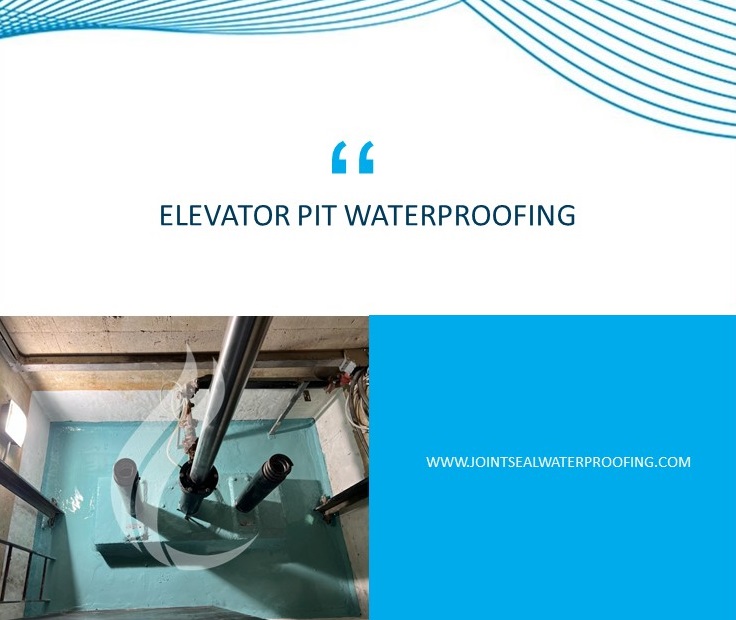
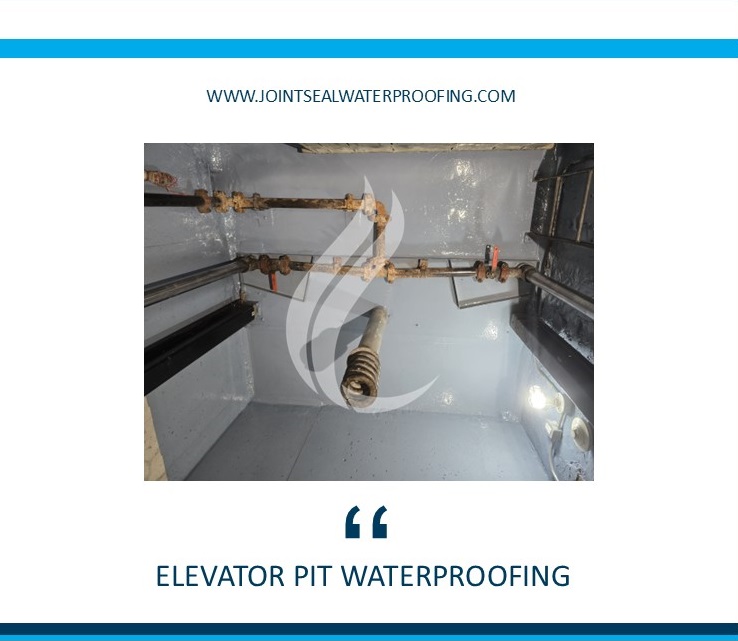
An elevator pit is the lowest point in the building and the one room guaranteed to collect whatever water gets into the structure. Waterproofing one properly is three separate jobs: the cold joints where the floor meets the walls, the pit floor and lower walls, and — on a hydraulic elevator — the piston housing itself. Skip any one of them and the pit is dry until the next thaw.
1. The cold joints
The junction where the floor slab meets the pit walls is the most common leak path. It is a cold joint — two pours that never bonded — and it runs the full perimeter.
- Chip and clean. The joint is chipped out and thoroughly cleaned so the repair bonds to sound concrete.
- Continuous patch at 45 degrees. A patch is installed along the entire length of the joint at a 45-degree angle, forming a cove instead of a square internal corner. A membrane asked to turn a 90-degree corner splits at the corner; a coved joint gives it a radius to follow.
- Waterproof over it. Waterproofing material is applied over the repaired joint.
- Fiberglass upturn. A fiberglass upturn is carried onto the walls around the entire pit perimeter, covering the cold joints as one reinforced continuous layer rather than a line of separate patches.
2. The pit floor and walls
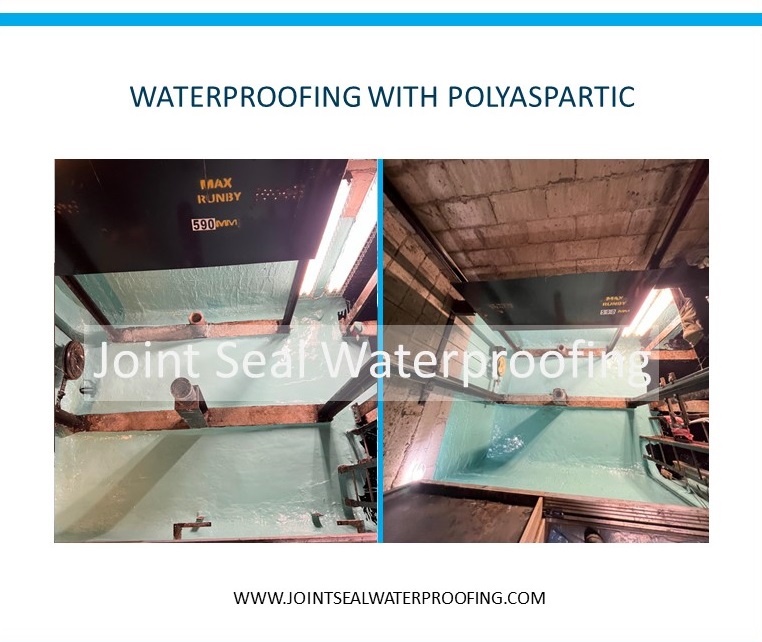
A polyaspartic waterproofing membrane is spread uniformly across the whole pit floor and up onto a portion of the walls, sealing the reinforced cold joints into the same continuous system. Polyaspartic is used here because it cures rapidly — which matters when an elevator is out of service — adheres hard to prepared concrete, and resists the wear a working pit sees.
3. The piston housing
On a hydraulic elevator the piston housing is its own waterproofing problem, and it is where many pit repairs quietly fail.
- Accumulated water is pumped out first.
- The top surface of the piston housing is cleaned thoroughly.
- A polyurea-based foam is injected into the housing to seal potential leak paths.
- Primer is applied and the newly placed concrete around the housing is coated, so the area is sealed continuously with the rest of the pit.
Scheduling in an occupied building
One car at a time. In a building with more than one elevator we take a single car out of service so at least one keeps running. Most repaired areas are back in service within 24 hours.
Materials carry a Ministry of Transportation Ontario rating for roughly a 25-year service life. That is a material service-life rating, not a warranty term.
A real example
A medical facility on Lake Shore Blvd. W in Etobicoke. The scope was the piston housing plus the entire elevator pit, including the cold joints between floor and walls — chipped, coved at 45 degrees, membraned, fiberglass upturn around the full perimeter, polyaspartic membrane over floor and lower walls, and the piston housing pumped, cleaned, foam-injected, primed and coated.
Where the water is actually coming from
Worth saying plainly: a pit that fills after every rain is usually not leaking through the pit. It is receiving water that entered the structure somewhere else and ran downhill. Before waterproofing a pit we look for the entry point — that is what infrared leak detection is for. Sealing the pit without finding the source turns a wet pit into a wet something else.
The opinion, stated plainly
Pumping a pit out on a schedule is not maintenance, it is a subscription. Water standing against pit walls corrodes reinforcing steel, damages the piston seal and the controls, and eventually turns a waterproofing job into a concrete job.
Related: elevator pit waterproofing and cleaning · cold joint repair · infrared leak detection · what is polyurea waterproofing · documented projects · common questions
Common questions
Frequently asked questions
Does the elevator piston housing itself leak?
The piston housing does not leak. It is a fully sealed steel cylinder holding the piston and its oil, and it does not degrade or fail in the way people assume. The water problem is around it, not through it — the void in the ground surrounding the housing fills with groundwater, and that water then rises into the elevator pit.
Can our building's superintendent just pump the elevator pit out?
Pumping an elevator pit out is reasonable as a first step and it is what most property managers do, but it treats the symptom. Pumping also does not tell you where the water came from — and if the pit is full of sediment and debris, nobody can see the entry point at all. The useful version is pumping, cleaning, and then inspecting the empty pit.
Can the TSSA shut down an elevator because of water in the pit?
The TSSA can condemn elevator equipment over water in the pit, and it does not need to catch the pit flooded to do it. Staining on the pit walls showing water has previously reached half a foot to a foot is enough evidence of a history. The equipment usually stays out of service until the pit is waterproofed, and sometimes until the equipment itself is serviced or replaced.
How do you find a leak in an elevator pit that isn't obvious?
Where the water path is not visible we use thermal imaging, which shows the saturated sections of an elevator pit clearly against the dry concrete. Read alongside the handful of ways water normally enters a pit, an infrared scan narrows it quickly. The harder judgement is predicting what fails next once the current path is sealed.
How long should elevator pit waterproofing last?
Properly installed elevator pit waterproofing generally holds around the ten-year mark, and we have had installations run well past five years even on pits where the walls were in poor condition to begin with. The variable is the substrate, not the coating — a pit with sound concrete lasts longer than one where the walls were already frail when we arrived.
Is a block-wall elevator pit worse than a poured concrete one?
A block-wall elevator pit is harder to keep dry than a poured concrete one, because block assemblies have hollow cores and mortar joints that give water more paths through the wall. Poured concrete has a cold joint at the floor and occasional cracks; block has a grid of potential paths. It changes the strategy more than it changes the cost.
Related services & repair types