Project & Insights
Concrete Repairs at a Gas Production Plant – Phase 2
August 18, 2021
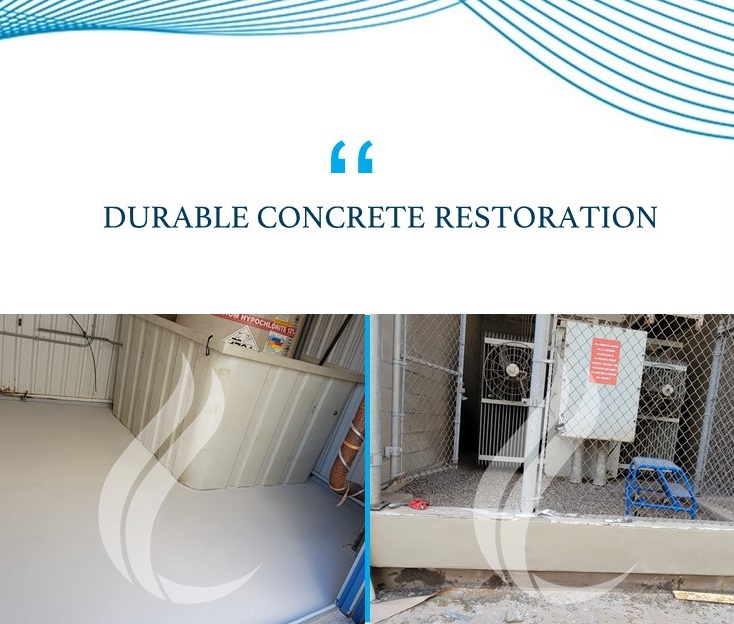
After successfully completing the first phase of repairs at a large gas-production company located in Hamilton, we were called back to work on the next phase which included the chemical and the transformer rooms.
Phase 2
The repairs required at this time were the floor of the chemical room and a concrete slab at the entrance to the transformer room.
Chemical Room Floor
Before painting the chemical room floor, we ground the surface in preparation for the first coat. Once applied, it was left to cure overnight, and the following day we applied the second coat, broadcasting it with sand, to ensure a non-slip surface.
Transformer Room Concrete Slab
To fully repair the slab, we ground its surface and fixed the cracks with an epoxy crack filler, applying patches, as needed.
Patching
Under traditional repair methods, patching requires a minimum of two-inch demolition in the affected area. The use of our specialized industrial-strength products permits thin patch applications, without use of any forming or concrete injection, making the job much more cost-efficient and faster.
This type of concrete repair involves three steps: removal of delaminated and unsound concrete, application of adhesive, and patch installation.
Learn more about our concrete repairs and waterproofing methods by visiting our page about patching: /patching
Related: industrial and plant concrete repair · food plant floor repair · thin-patch concrete repair · floor coating systems · documented projects · common questions
Common questions
Frequently asked questions
When can concrete repairs be done in a plant that never shuts down?
Inside a planned window rather than at a time that suits the contractor. Statutory holidays are the big ones, and we have worked Christmas at plants where that is one of only a couple of full shutdown days in the year. Otherwise the work fits a wash-down cycle or a changeover on one line while the rest of the plant keeps running.
Does curing time come out of the shutdown window?
Yes, and it is the most common planning mistake we see. Surfacing and coatings want at least twenty-four hours before traffic goes back on, and that has to sit inside the window. A five-day shutdown is really four days of work and one day of waiting. Any programme that treats cure as something happening after handover will put traffic on green material.
How is dust controlled when grinding inside an occupied facility?
With HEPA-filtered vacuum extraction on the grinding and chipping, plus containment of the work area set up before any tool is switched on. In a food plant the cleanliness requirement is absolute, so there is no version of the job where dust gets dealt with afterwards. The same approach applies in hospitals and other occupied buildings.
Why seal around the feet of tanks and machines?
Levelling feet leave a gap between the plinth and the floor, and that gap is dark, permanently damp and impossible to clean or inspect. Sealing around the foot closes it, so nothing can get underneath and a glance is enough to confirm the area is clean. We have done close to forty of these at one plant and none has failed, against a previous detail that was not lasting four months.
Why do trench drain edges break before the rest of the floor?
The drain edge is the only part of the floor with nothing supporting one side of it. A loaded forklift or vehicle wheel crossing the grating lands on an unsupported lip, and that same lip sits in whatever runs down the channel all day. Concentrated load and constant wetting attack the same twelve inches of concrete, so the edge fails years before the slab around it shows anything.
How far back from a trench drain does the repair have to go?
Where heavy wheel traffic crosses, plan on twelve to eighteen inches either side of the channel, taken below slab level to a compacted stone base. On a recent sixty-foot edge rebuild we broke back roughly a foot to a foot and a half and dug down more than a foot before reaching sound material. The width is set by where good substrate starts, not by how wide the damage looks.
Related services & repair types