Project & Insights
Parking Garage Floor Repair & Traffic Topping | Joint Seal
February 1, 2023
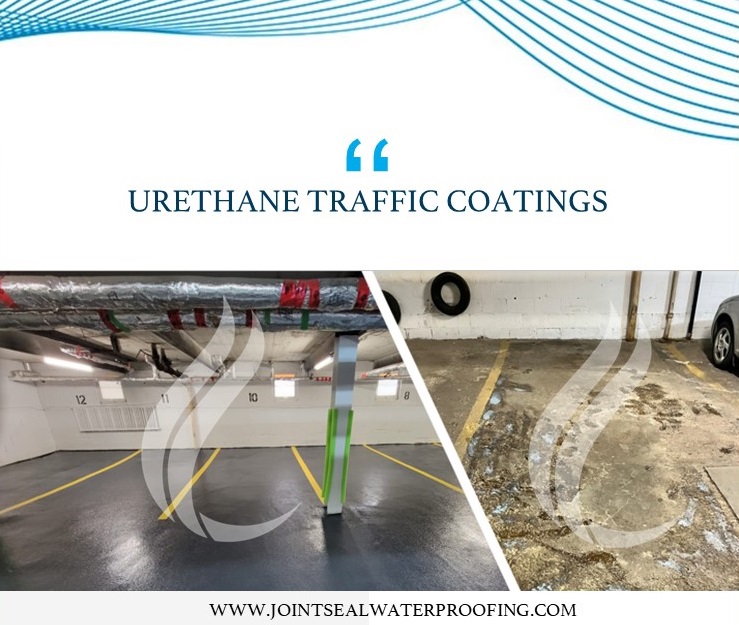
A garage floor is not resurfaced. It is rebuilt from the substrate up, and the traffic topping is the last and thinnest part of the job. Cracks are opened and filled, broken areas are patched, the whole slab is shotblasted back to clean sound concrete, the cracks that shotblasting exposes are repaired too — and only then does the urethane membrane go down.
Skip any of those steps and the coating telegraphs the defect underneath within a season.
What a full garage floor restoration involves
1. Crack repair and patching. Cracks are opened up and cleaned out so the specialised crack filler bonds to sound concrete rather than to dust and laitance. Broken and delaminated areas are patched. On a badly deteriorated slab, parts of the surface will be completely broken up, and those areas are rebuilt rather than filled.
2. Shotblasting. The whole floor is shotblasted. This does four things at once: it removes cracked and damaged surface concrete, it strips the oil and grease that every parking floor accumulates from vehicles, it leaves a profiled substrate the membrane can key into, and it exposes defects that were invisible under the old surface.
3. A second round of crack repair and patching. This step is the one that gets dropped from cheap quotes. Shotblasting always finds more than the walk-through did. Repairing what it uncovers, before coating, is the difference between a floor that lasts and a floor that blisters.
4. Urethane membrane. Base coat and top coat, applied over a substrate that is now clean, sound and profiled. Urethane traffic topping is engineered to flex with a slab that moves and to take tyre traffic, de-icing salt and point loads — it is a different product family from a decorative floor coating, even though both get called a floor coating.
Why shotblasting rather than grinding or washing
Adhesion. A urethane membrane bonded to a contaminated slab will lift, and the most common contaminant in a garage is exactly what the cars leave behind. Shotblasting also produces no slurry to contain and leaves no loose chunks of concrete on a floor that residents are walking across the next morning.
What this looks like on a real job
At a low-rise residential building on Bloor St. W in Toronto, we restored 4,500 square feet of garage floor. The concrete surface was severely damaged, with sections completely broken up. The sequence was exactly the one above: crack repair and patching, shotblasting, a further round of crack repair and patching, then the urethane membrane.
How much of the garage closes?
Not all of it. Work is phased by level or by bay so the garage keeps operating, which is the same principle we use on expansion joint work — a 20-foot joint span needs roughly ten parking spots vacated and takes about two days, and the garage does not close. Most repaired areas are back in service within 24 hours.
The materials carry a Ministry of Transportation Ontario rating for roughly a 25-year service life. That is a material service-life rating, not a warranty term.
What we do not do
Joint Seal does concrete repair, restoration and waterproofing only. We do not stripe, we do not take on general trades work, and we will not coat a slab we have not been allowed to prepare properly. A topping over unrepaired concrete is a cosmetic exercise with a service life measured in seasons.
The opinion, stated plainly
When two garage floor quotes are far apart, the gap is almost never the membrane. It is whether shotblasting and the second round of patching are in the scope. Ask both bidders what happens between preparation and coating — the honest answer is usually more work than the cheap quote contains.
Related: parking garage waterproofing and repair · traffic toppings and traffic deck repair · floor coating systems · concrete crack repair · documented projects · common questions
Common questions
Frequently asked questions
Are cracks in a parking garage slab structural?
Cracks in a parking garage slab are usually not structural in themselves, but they are the path by which chloride-laden water reaches the reinforcing steel, and corroding steel is structural. The width and the wetness matter more than the length. A wet crack in a drive lane deserves attention before a dry crack twice its size.
Can a thin patch be used on a parking garage ceiling?
Thin patching works overhead as well as on floors and walls, but the material has to hold its shape against gravity while it cures. Structural patch materials with a clay-like consistency are made for this and will not sag or drip off a soffit. We have patched garage ceilings, walls, floors and ramps in a single campaign with one system.
How soon after patching can cars go back on a garage level?
Most of our patching in occupied parking garages is back under traffic the same day or the next, because the adhesive and polymer cements cure in about four hours rather than the days conventional concrete needs. On one Scarborough garage floor repair the self-levelling material cured in under thirty minutes and the level reopened within a few hours.
Is a delaminated patch a structural problem or a cosmetic one?
A single delaminated patch in a parking garage slab is usually not structural on its own, but the open seam lets salt water reach the reinforcing steel, and corroding rebar is structural. The patch is the symptom. What matters is how long the water has had a path in, which is why deferred patching gets more expensive rather than staying the same price.
Does the whole garage have to close for ceiling repairs?
A parking garage does not usually close for ceiling repair, because the work is staged in sections with cars moved out of the affected bays only. Patch materials cure in around four hours, so a section is rarely out of service long, and the coating over the top generally sets the schedule rather than the patch.
Can you paint or coat over a spalled ceiling instead of patching it?
Coating over spalled concrete without repairing it hides the symptom and does nothing about the corroding steel underneath, so the coating fails as the cover continues to break away. Any coating is the last layer of a system, applied after the loose material is removed, the steel treated and the profile rebuilt.
Related services & repair types