Project & Insights
Polyaspartic Coatings for Stair Waterproofing
July 26, 2023
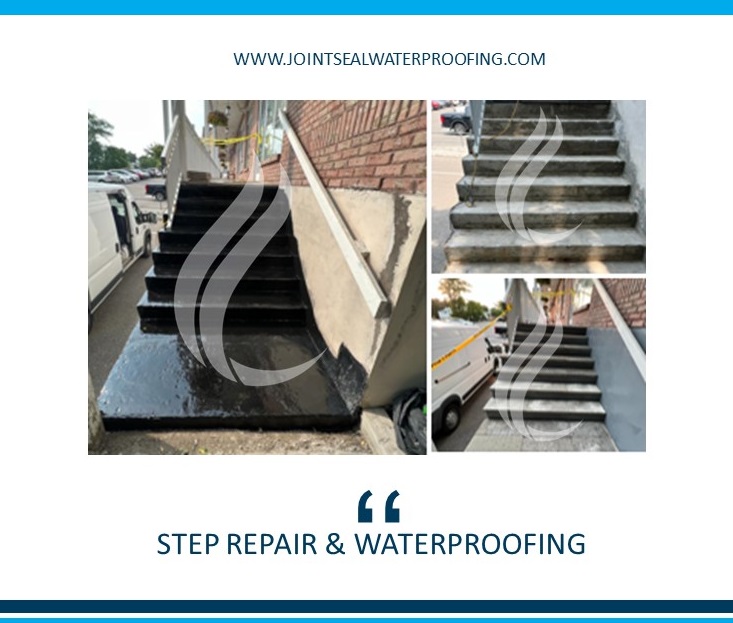
Last week brought more step repair projects, this time at a building located on Islington Ave. in Vaughan where a tile-covered staircase required waterproofing. Tiles had to be removed, some crack repair done, a waterproofing membrane installed, and the tiles were to be placed back.
Repair Method
All the tiles had to be removed carefully so that they could be used again. Slight grinding was done to prepare the entire surface for membrane installation, to ensure proper adhesion. Cracks were repaired, as needed: they were opened up, cleaned out, coated with adhesive, and filled with a specialised crack-filling material.
One all the steps were sound again, they were coated with a polyurea-based waterproofing membrane. A polyaspartic coating followed, broadcast with silica sand. As the last step of the repair, the tiles were put back.
The Power of Polyaspartic Coatings
Polyaspartic coatings have become a game-changer in the world of protective coatings due to their exceptional properties and versatility.
Swift Curing Time
Polyaspartic coatings have a remarkably fast curing time, allowing for efficient project completion. As the staircase restoration commenced, the quick curing nature of polyaspartic coatings ensured minimal downtime. Within a short period, the stairs were ready to welcome foot traffic again.
Superior Durability and Longevity
High-traffic areas like staircases and balconies demand coatings that can withstand heavy use and harsh environmental conditions. Polyaspartic coatings excel in this aspect, providing exceptional durability and longevity, even when exposed to the weather elements (which was not the case with this project).
Aesthetic Enhancement with Flakes
Aside from the practical benefits, polyaspartic coatings also elevate the aesthetics of the restored structures. To achieve a fresh and renewed look, the polyaspartic coating can include decorative flakes – in this case, the client preferred to reuse the tiles, though.
Seamless and Protective Finish
Polyaspartic coatings offer a seamless finish, eliminating any concern about water seepage or damage. To ensure the stairs were fully protected and sealed, this membrane was used as an additional layer between another polyurea-based membrane and the stones.
Polyaspartic coatings have undoubtedly revolutionized the way we approach protective coatings and restoration projects. They can be used as one or more layers to fully seal the surface, as well as include decorative flakes for a unique finish and work as a top coat.
For more details on step repair and restoration, see this page: /stairs
Related: concrete step and stair repair · floor coating systems · polyaspartic vs epoxy floor coatings · thin-patch concrete repair · documented projects · common questions
Common questions
Frequently asked questions
Can precast concrete stairs be repaired, or do they have to be replaced?
Precast concrete stairs with cracked or spalling nosings can be repaired in place in the large majority of cases. Replacement is rarely necessary unless the structural slab of the staircase itself has failed. The repair rebuilds the step geometry with sculpted polymer cement and then coats the staircase; replacement means demolition and recasting at roughly four to five times the cost.
How long does a concrete stair repair take?
A typical concrete stair repair takes about two days — one day of preparation and one of application — and the stairs can be used almost immediately afterwards, because the materials cure in hours rather than days. Recasting the same staircase takes one to two weeks with the stairwell closed throughout.
Do the stairs have to be closed while they are repaired?
A staircase wide enough to work on in halves does not have to close: the left side is repaired while residents use the right, then the sides switch. On a narrow staircase the closure is measured in days rather than weeks. This matters because a stairwell is emergency egress and cannot simply be taken out of service.
Is spalling on exterior concrete steps a safety issue?
Spalling on the nosing of a concrete step is a tripping hazard and a safety violation, because the walking edge is exactly where people put their weight. It is also where water and road salt reach the reinforcing steel. Deferring the repair means the rebar corrodes and the scope grows from a surface repair into a structural one.
What makes a repaired staircase non-slip?
The non-slip surface comes from the top coat — either a UV-resistant coating that is non-slip in itself, or a membrane with an anti-slip aggregate broadcast into it. On exterior stairs this is not optional. A smooth coated step in a Toronto winter is worse than the damaged concrete it replaced.
What temperature is too cold for concrete repair in Toronto?
Concrete repair needs air temperature above plus five degrees Celsius, because below that ice crystals form in the substrate and no repair material will bond to them. Plus ten degrees is where most materials genuinely perform. Between five and ten, the morning-to-evening temperature swing creates enough dew that the work needs materials tolerant of a damp surface.
Related services & repair types