Project & Insights
Concrete Floor Repairs
February 17, 2021
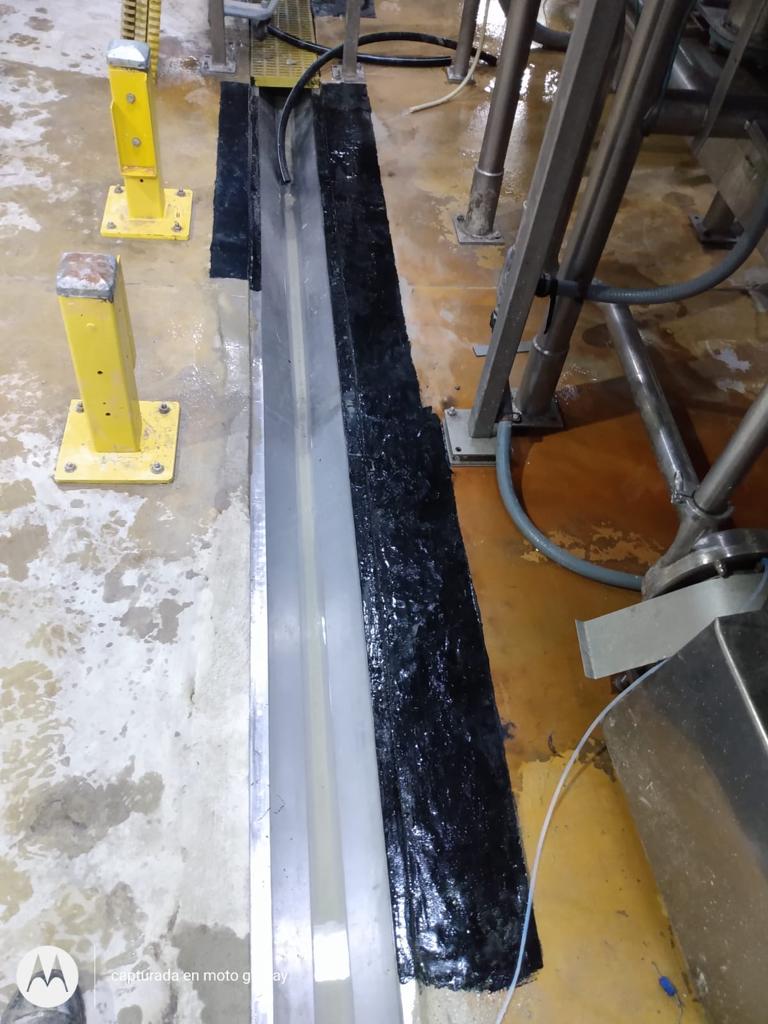
More waterproofing was done at the food processing plant in south Etobicoke.
Trench drains run throughout the processing areas to allow for continuous water discharge (water runs across the floor and into the drains). Because the water is highly acidic, it breaks up the concrete floor and flows under the floor slab before it can go into the drain, further eroding the surface.
Besides, drainage trenches are made of stainless steel, which would normally make it impossible for concrete to adhere to them.
Our Solution
We had to seal around the drain, ensuring the repaired surface would withstand the acidity and be completely flat.
Our crew did minimal demolition (just 5 mm deep) around the drain, to be able to install a concrete patch that would be level with the floor, to allow for continuous draining. Thanks to our specialized materials, the patch fully adhered to the old concrete and to the metal edge of the drain. As a final touch, cold-applied polyurea membrane was applied, ensuring complete waterproofing.
Water continues flowing over the patch and into the drain, without getting under the floor slab.
Related: concrete repair and restoration · thin-patch concrete repair · floor coating systems · mechanical room floor coating · documented projects · common questions
Common questions
Frequently asked questions
Why does water pond on a floor that used to drain properly?
Usually the floor did not change, the room did. Partition walls get added, a line moves, one room becomes two, and drains that were correctly placed for the original layout end up somewhere the water never reaches. The slab still falls exactly the way it was poured. It just no longer falls towards a drain.
Is a delaminated patch a structural problem or a cosmetic one?
A single delaminated patch in a parking garage slab is usually not structural on its own, but the open seam lets salt water reach the reinforcing steel, and corroding rebar is structural. The patch is the symptom. What matters is how long the water has had a path in, which is why deferred patching gets more expensive rather than staying the same price.
How long before a thin patch can be walked on or driven on?
Polymer cement patches with Polyforce Plus adhesive cure in roughly four hours, comparable to how long conventional concrete takes to set, so most repairs take foot traffic the same day. Temperature affects it, and whatever coating goes over the patch usually governs the return-to-service date rather than the patch itself.
What is a sounding test on concrete?
A sounding test is tapping concrete with a specialised hammer or a metal rod and listening to the response. Solid concrete rings; delaminated concrete sounds hollow. It is the test that decides whether a crack gets injected or the surrounding area gets removed and patched, and it finds damage that looks completely sound to the eye.
Is it cheaper to move a floor drain or to re-slope the floor?
Re-sloping is almost always cheaper and less disruptive. Relocating a trench or point drain means breaking the slab, cutting into the drainage line and re-tying it, which is a far bigger excavation and a much longer shutdown. In a two thousand square foot production room with three drains in the wrong places, we re-sloped the floor rather than move any of them.
What temperature is too cold for concrete repair in Toronto?
Concrete repair needs air temperature above plus five degrees Celsius, because below that ice crystals form in the substrate and no repair material will bond to them. Plus ten degrees is where most materials genuinely perform. Between five and ten, the morning-to-evening temperature swing creates enough dew that the work needs materials tolerant of a damp surface.
Related services & repair types