Project & Insights
Food Plant Floor Repair Toronto | Joint Seal
February 24, 2023
A food plant floor does not fail the way an office floor fails. It fails at the drain edges, at the wall-to-floor corner, and around the feet of the equipment — the three places where wash-down water, acid and thermal shock all arrive at once. The repair that survives is a monolithic system that goes back down in sections thin enough to work around live production, and it is scheduled around the plant’s calendar rather than the contractor’s.
Why plant floors fail at the edges first
In a wash-down environment the floor is cleaned harder than it is used. Caustic and acidic cleaners run to the drains, so the concrete nearest the drain sees the highest chemical load and the most thermal cycling. Hot water at 70 degrees hitting a cold slab expands the surface faster than the mass behind it, and the bond line lets go. That is why delamination shows up as edges and patches rather than as a floor that wears out evenly.
An acidic environment also attacks the cement paste directly, which is why an ordinary repair mortar placed in a plant lasts a fraction of the time the same mortar lasts in a garage.
What we use, and why
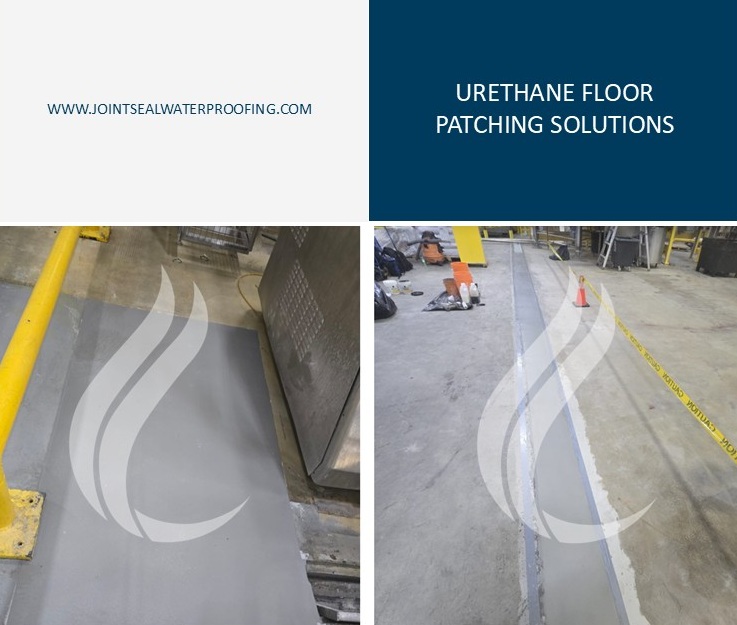
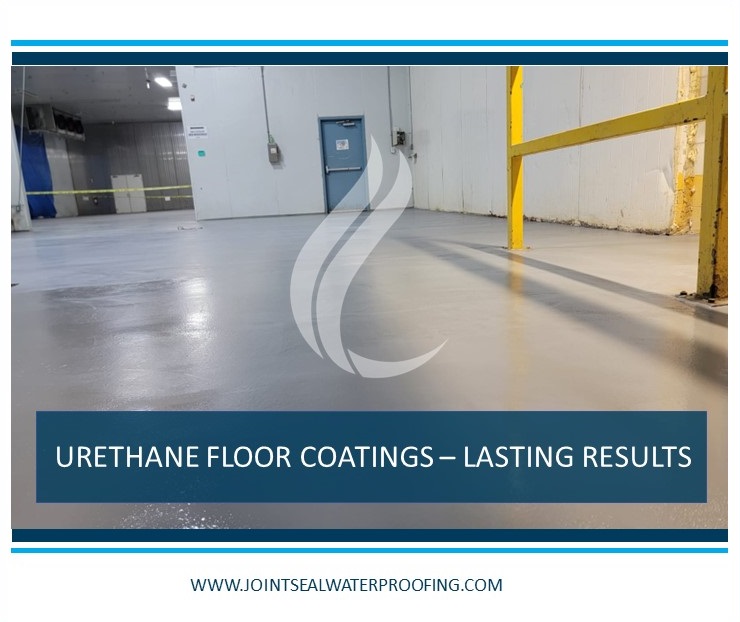
Cementitious urethane for the floor field. It tolerates thermal shock, resists the acids and caustics used in cleaning, and can be laid as a screed thick enough to rebuild a delaminated area rather than merely coat over it.
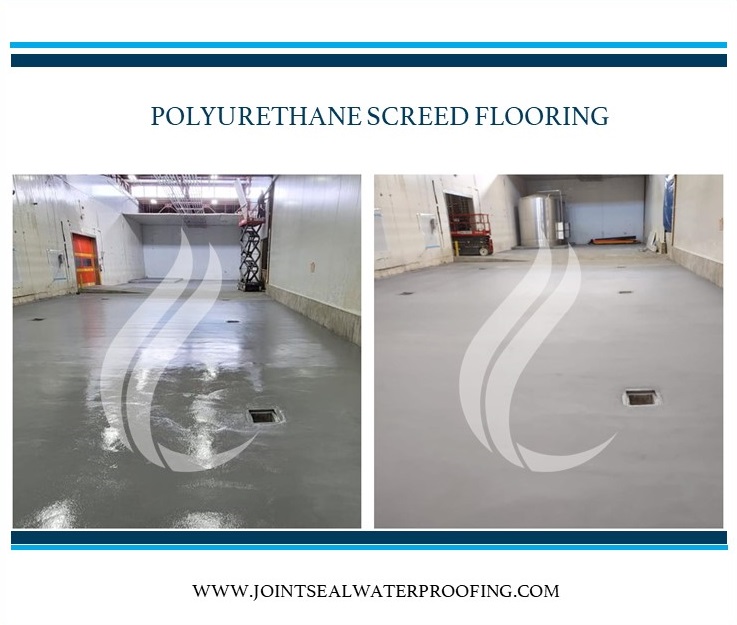
Polyurethane screed where the requirement is a hard-wearing, seamless, bacteria-resistant surface that stands up to heavy foot and cart traffic and to the chemicals used in production. Seamless matters more than it sounds: every joint, crack and lifted edge in a plant floor is a place bacteria sit where cleaning does not reach.
Polyforce Polymer Cement with Polyforce Plus Adhesive for localised structural patching. It bonds in sections as thin as 5 mm, against the two-inch minimum chip-out that demolition-and-recast repair requires. In a plant, that difference is the whole job — a 5 mm patch can be placed around a machine that stays bolted down, while a two-inch chip-out means the machine comes out and the line stops.
Materials carry a Ministry of Transportation Ontario rating for roughly a 25-year service life. That is a material service-life rating, not a warranty term.
How the work fits a plant that never stops
Three constraints govern everything:
- Production does not stop. Work is phased into whatever window the plant has — a shift change, a sanitation window, a statutory holiday. On one South Etobicoke plant we have worked in phases since January 2021, and the delamination repairs were carried out over Christmas, when the fewest staff were on site.
- Access is restricted and space is confined. Repairs happen around live equipment, in the gaps the plant actually has, not in an empty room.
- The work area must stay free of contaminants. Grinding dust is contained at source rather than ventilated into the production area, and the repair area is isolated before any surface prep starts.
Most repaired areas are back in service within 24 hours. Curing time is the constraint that decides whether a section fits the window, and it has to be counted inside the shutdown, not after it.
What we do not do
Joint Seal does concrete repair, restoration and waterproofing only. We do not take general trades work, we do not relocate drains or alter process piping, and we do not certify a floor as food-grade — that is the plant’s specification to set and ours to build to. Where water ponds because the room changed around the drain, the fix inside our scope is re-sloping the floor to the drain that already exists.
A real example
A large food-processing plant in South Etobicoke, a long-term client since January 2021. The scope over the holidays was delaminated areas of varying size scattered across the premises — not one big pour, but many small ones, each around equipment, in confined space, in an acidic environment, with production running. Every area was rebuilt in cementitious urethane, section by section, to a schedule set by the plant.
The opinion, stated plainly
Most plant floor failures are not material failures. They are sequencing failures: someone specified the right product and then gave it a curing window it never had, or coated over a delaminated edge because chipping it out meant moving a machine. If the quote does not say what happens at the drain edges, the coving and the equipment feet, it is quoting a surface, not a floor.
Related: industrial and plant concrete repair · floor coating systems · thin-patch concrete repair · mechanical and utility room floors · documented projects · common questions
Common questions
Frequently asked questions
Does an entire floor repair have to be food-grade in a food plant?
No. Layers that end up buried and sealed under the finish can be ordinary materials, including compacted stone and the concrete that shapes the fall. It is generally only the final inch or so that has to meet the food-grade requirement, applied as a base coat and a top coat. Specifying certified material through the full depth of a repair is a common and expensive mistake.
Can a cheaper coating be used in the non-production areas of a plant?
In genuine office and administrative space, yes. The trap is that some rooms look administrative and are not. We were once asked to use a cheaper epoxy in what was described as an office area, and on walking it we found the micro testing lab where quality control work is done. We flagged it, the engineers agreed, and it was finished in food-grade material.
When can concrete repairs be done in a plant that never shuts down?
Inside a planned window rather than at a time that suits the contractor. Statutory holidays are the big ones, and we have worked Christmas at plants where that is one of only a couple of full shutdown days in the year. Otherwise the work fits a wash-down cycle or a changeover on one line while the rest of the plant keeps running.
Does curing time come out of the shutdown window?
Yes, and it is the most common planning mistake we see. Surfacing and coatings want at least twenty-four hours before traffic goes back on, and that has to sit inside the window. A five-day shutdown is really four days of work and one day of waiting. Any programme that treats cure as something happening after handover will put traffic on green material.
Why seal around the feet of tanks and machines?
Levelling feet leave a gap between the plinth and the floor, and that gap is dark, permanently damp and impossible to clean or inspect. Sealing around the foot closes it, so nothing can get underneath and a glance is enough to confirm the area is clean. We have done close to forty of these at one plant and none has failed, against a previous detail that was not lasting four months.
Why do trench drain edges break before the rest of the floor?
The drain edge is the only part of the floor with nothing supporting one side of it. A loaded forklift or vehicle wheel crossing the grating lands on an unsupported lip, and that same lip sits in whatever runs down the channel all day. Concentrated load and constant wetting attack the same twelve inches of concrete, so the edge fails years before the slab around it shows anything.
Related services & repair types